Pannonhalma: Instructions Unclear, Ended Up with Wine
Pannonhalma: Instructions Unclear, Ended Up with Wine
Day six. A thousand years of patience, another bloody Camino shell, and Carol’s continuing responsibility for getting me home.
They put the Stations of the Cross on the climb to the abbey.
An unusually honest piece of visitor management.
You are going uphill, considering your choices, and at regular intervals the Church reminds you that somebody else had a substantially worse afternoon. Complaints become difficult to formulate without sounding petty.
I formulated one anyway.
“It’s oddly appropriate that they put the Stations of the Cross on the oppressive climb to the abbey.”
Pannonhalma was above us. We were below it. The arrangements for correcting this imbalance were entirely pedestrian.
After yesterday’s House of Terror, we had come out of Budapest to a hill with a Benedictine monastery on it.
I was ready for a different use of stone walls.
The sky was mostly cloud, the light soft enough to let you look at things without squinting. The town spread below the abbey, roofs giving way to fields, the countryside extending well beyond any immediate obligation to understand it.
The monastery was founded in 996. Prince Géza brought the monks here; his son, the future Saint Stephen, continued the work and secured the monastery’s privileges. The abbey’s account of its beginnings places it right at the formation of Christian Hungary.
Nine hundred and ninety-six.
I tend to think of a building as old when its electrical sockets are inconvenient. This required a different scale.
Of course, a monastery that has existed for a thousand years has been rebuilt, extended, interrupted, and repaired. The people who began it did not finish everything and leave a note asking the next forty generations to avoid touching the paint.
You can see the accumulated decisions. A doorway. A tower. An addition. Somebody in one century solving a problem left by somebody in another.
And still, monks live here.
That changes the visit. You are walking through a place where the activity that justified the building continues. The visitors come and go; there is a life here that will carry on after we have gone down the hill.
Inside the basilica, I looked up.
Ribs of stone crossing overhead. Painted figures between them. Light entering through a great circular window at the far end, too bright in the photograph to hold all its detail.
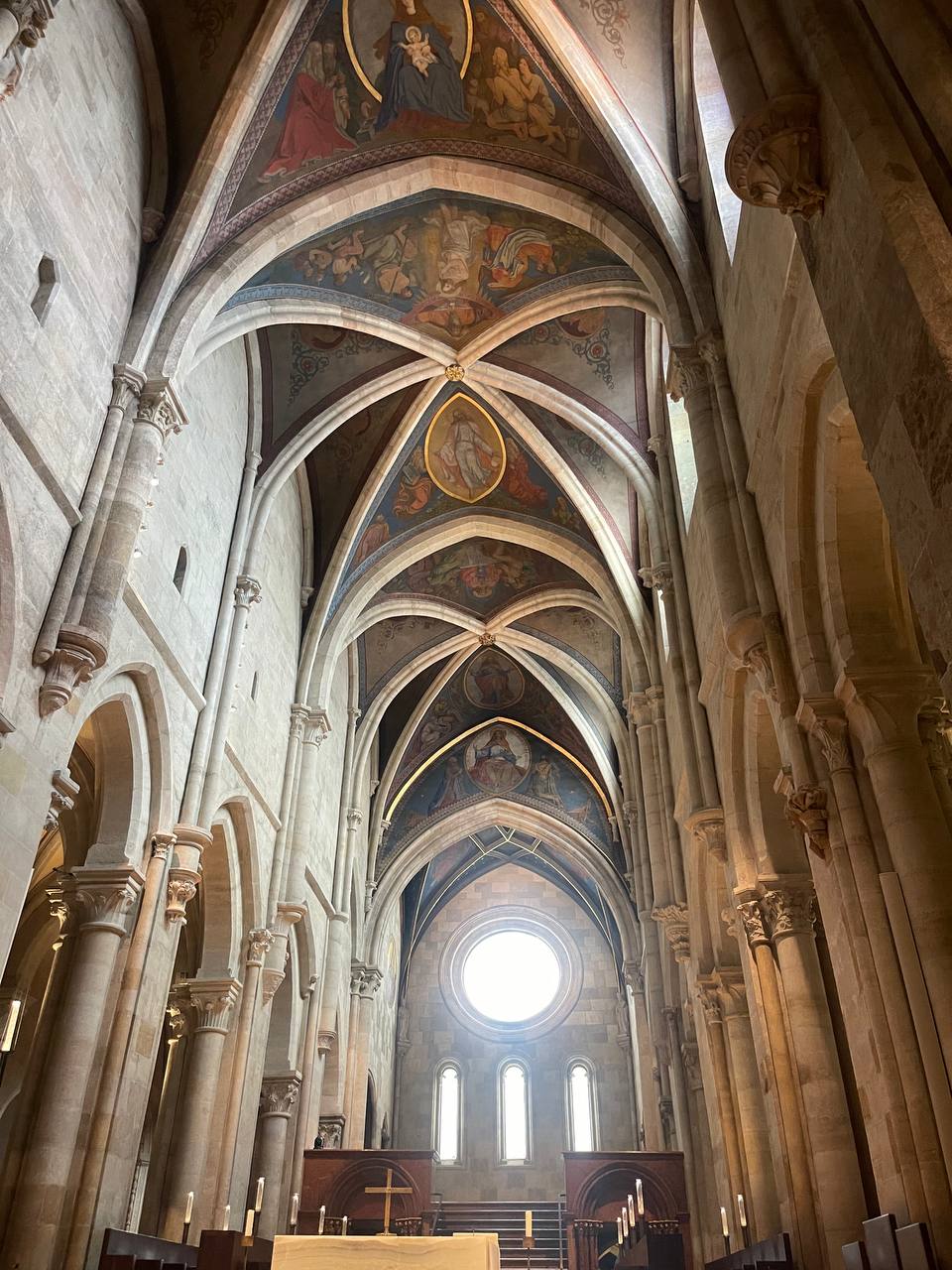
The architecture makes a fairly persuasive case for looking above your own eye level.
The basilica has a thirteenth-century core; the cloister beside it is late Gothic, with later alterations. UNESCO’s description is useful for separating the centuries. Standing there, I was mostly interested in how they felt together.
There is an intelligence to a room that can bring your voice down without asking twice.
I had questions, naturally. Stained glass. Figures in robes. A crown being offered. A bishop. Images whose meaning would once have been more readily understood by people who could not read than it was by this particular visitor with a phone and access to the internet.
We have become very good at retrieving information. Recognition remains a separate skill.
I took photographs and looked some more.
Silentium.
The word suited the cloister.
A covered walk around a courtyard. Pale walls, windows, plants gathered beneath them, a stone wellhead in the middle. Trees occupying a generous portion of the available sky.
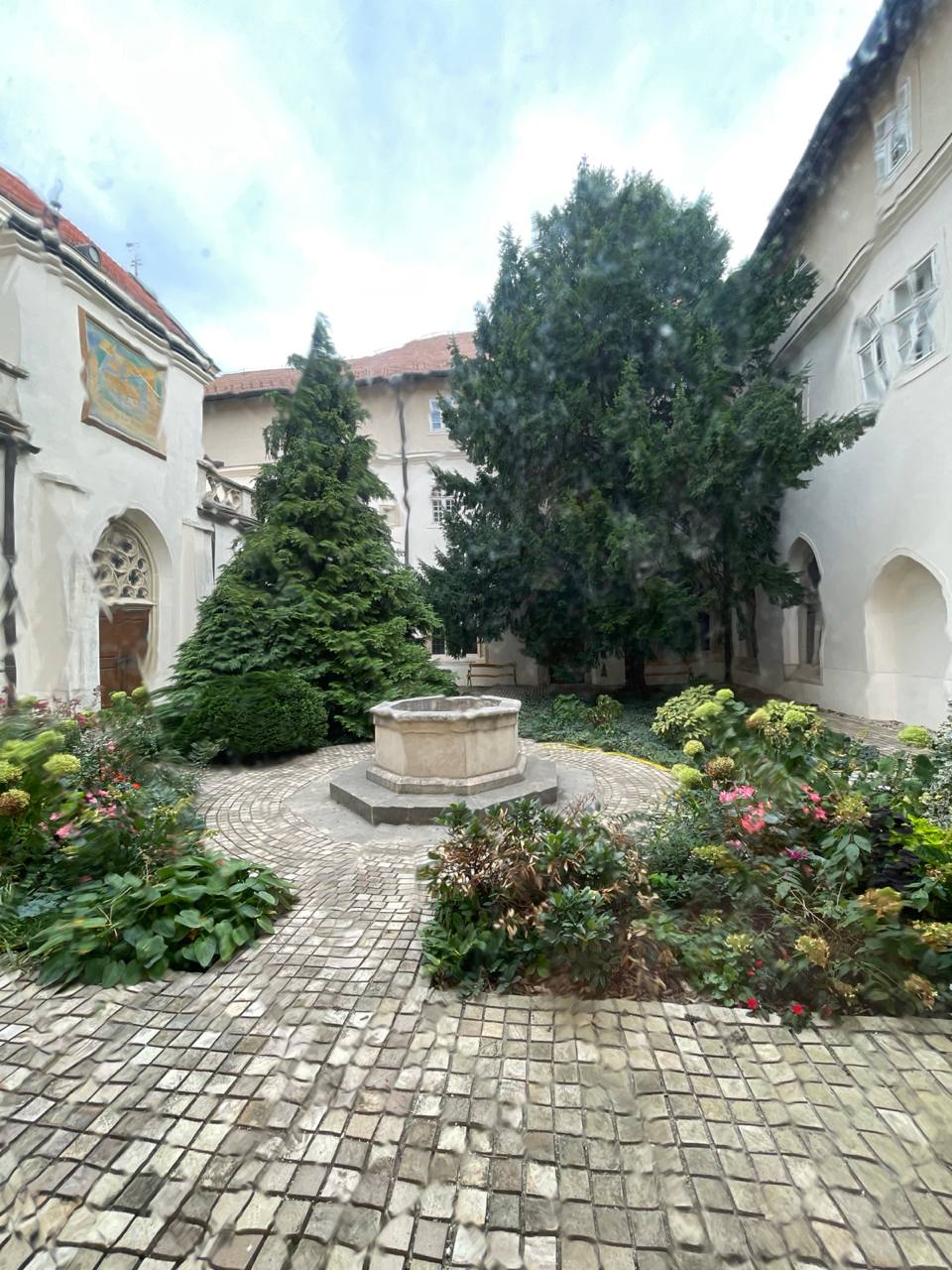
The courtyard seemed to have been arranged by people who understood that an empty centre can be useful. Leave somewhere for the eye to settle. Give the weather a way in. Let a tree do something that does not require an explanation.
I liked it.
After yesterday, I particularly liked being in an enclosed space where I wanted to stay for a moment.
There was more stained glass along the walk. I tried to work out the sequence of the scenes, counting what I could see. Then another detail caught my attention, and the counting became less important than the looking.
This is probably the closest I came all day to a contemplative discipline.
It lasted until I found some writing I could not decipher.
The stone had a name on it.
IVLIO PATERNO.
To Julius Paternus.
The Roman stone catalogue identifies it as his funerary inscription. The surface is worn and damaged, but the letters are still there, holding on well enough to prompt a stranger to stop and ask about them.
I find that sort of thing difficult to walk past.
A name is such a small piece of a person. It tells you almost nothing about what it felt like to know them. Whether they were funny. Whether they were kind. Whether they were a tiresome bastard about the proper way to do things.
Yet somebody put this one in stone.
Somebody wanted it kept.
And here I was, on a Thursday in October, looking at it.
The monastery was already asking me to think in centuries. This had reached back further and supplied an individual.
Then the library.
Oh, that room.
Shelves rising above shelves. Dark bindings, gold lettering, columns, a painted ceiling, light from tall windows spreading across the patterned floor.
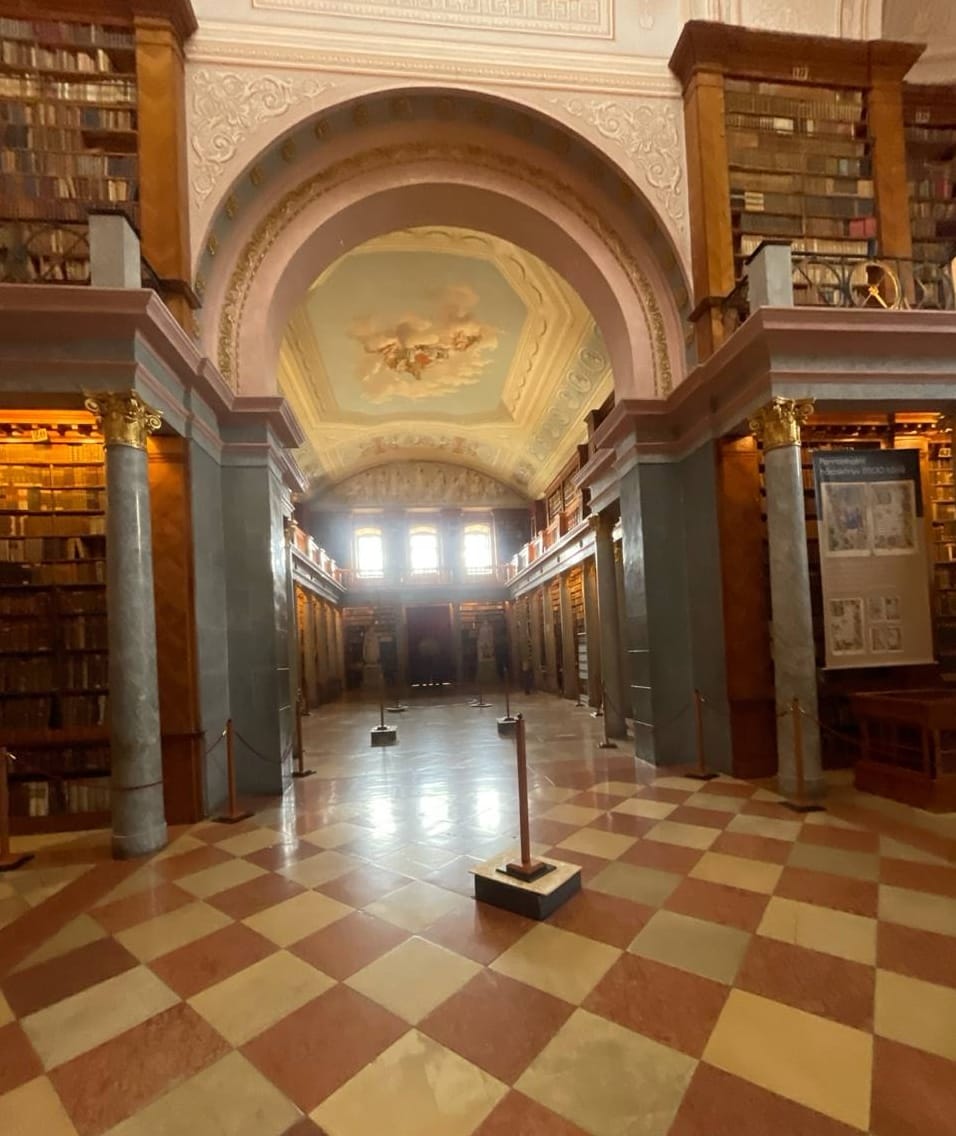
There are rooms in which a person can feel underdressed intellectually.
This is one of them.
I photographed the spines. Latin titles, volumes gathered into sets, letters rubbed pale through use and time. Opus Morale caught my eye. A substantial amount of moral instruction, judging by the shelf space. I hoped there would be a chapter covering sarcasm, though I suspected the conclusions might be inconvenient.
The present library hall is nineteenth-century and neoclassical. It looks entirely comfortable belonging to an institution much older than itself. The books have enough visual presence to make even the furniture feel patient.
There is also a recent story behind those full shelves, which I found when looking into the place afterwards.
The library closed in 2025 after a bread-beetle infestation threatened roughly a hundred thousand volumes. The abbey reports that the hall reopened in January 2026, following an extensive rescue effort. Books were packed, treated in an oxygen-free environment, cleaned, checked, and returned to disinfected shelves.
Centuries of scholarship, briefly endangered by something with no opinion about the contents.
There is a lesson in that, though the immediate one is probably to employ good conservators.
It also makes the word survived feel inadequate. Books do not survive because they are old enough to deserve it. Someone notices the damage. Someone moves them. Someone cleans a page, repairs a binding, finds the money, comes back tomorrow.
The room looked serene because a great many people had been busy.
The charter displays took me back another several hundred years.
Dense Latin. Abbreviations. Tall letters across the top. The sort of handwriting that makes you wonder whether medieval scribes were paid according to how much confidence they could remove from future readers.
One display showed the founding charter of Tihany, issued by Andrew I in 1055. Another showed Stephen’s charter for Pannonhalma. The abbey’s archives preserve both histories, including documents that came here from other monasteries.
Tihany’s charter has a particular importance: Hungarian words and phrases appear within its Latin text. An early written trace of the language, surviving inside the practical business of defining an abbey’s possessions.
I like that the ordinary work of being specific can become extraordinary with time.
Someone needed to say which place, which boundary, which bit of land. Nearly a millennium later, people lean towards the writing because of what those necessary details preserved.
I had also wondered whether one document marked the elevation to archabbey status. That belongs to a later chapter: Pannonhalma became the head of the Hungarian Benedictine congregation in 1514.
An institution this old has accumulated a considerable amount of paperwork.
It has also had to get through periods when paperwork offered limited protection. Joseph II suppressed the monastery in 1786; the Benedictines returned in 1802. Continuity here includes having to begin again.
That is harder work than simply remaining picturesque.
There was an illustration of the coronation mantle associated with Saint Stephen: gold figures spread across a blue ground, arranged around the shape of the garment.
The original began as a liturgical vestment, donated by Stephen and Queen Gisela to the church at Székesfehérvár in 1031, and was later adapted for coronations.
Even royal clothing can have a second career.
Looking at the illustration, I thought about the labour in it. Each figure had to be made. Each piece of the design had to pass through somebody’s hands. We look at a king’s mantle and remember the king. Somewhere behind all that splendour are the people who had to finish it.
By then I had looked at enough closely worked things to need a little open ground.
First, naturally, the gift shop.
The soul may be nourished freely, but there are other opportunities available on the way out.
The lavender was quiet.
October had taken the summer performance out of it. Low rounded plants, grey-green, a trace of scent when you paid attention. Enough to register, without requiring my sinuses to become involved in the itinerary.
I tried to imagine the fields in full bloom.
To me, It would smell like hay fever.
A less marketable description than the tourism department might prefer, but a sincere contribution.
Today it was subtle. I appreciated subtle after yesterday.
The wine shop was closed, which briefly threatened to introduce an element of deprivation into our monastic visit.
I adapted.
There was a café. There was a glass of pink wine and a pastry. In my notes I recorded the outcome with the precision it deserved:
“Instructions unclear, ended up with wine.”
Lavender wine, in fact.
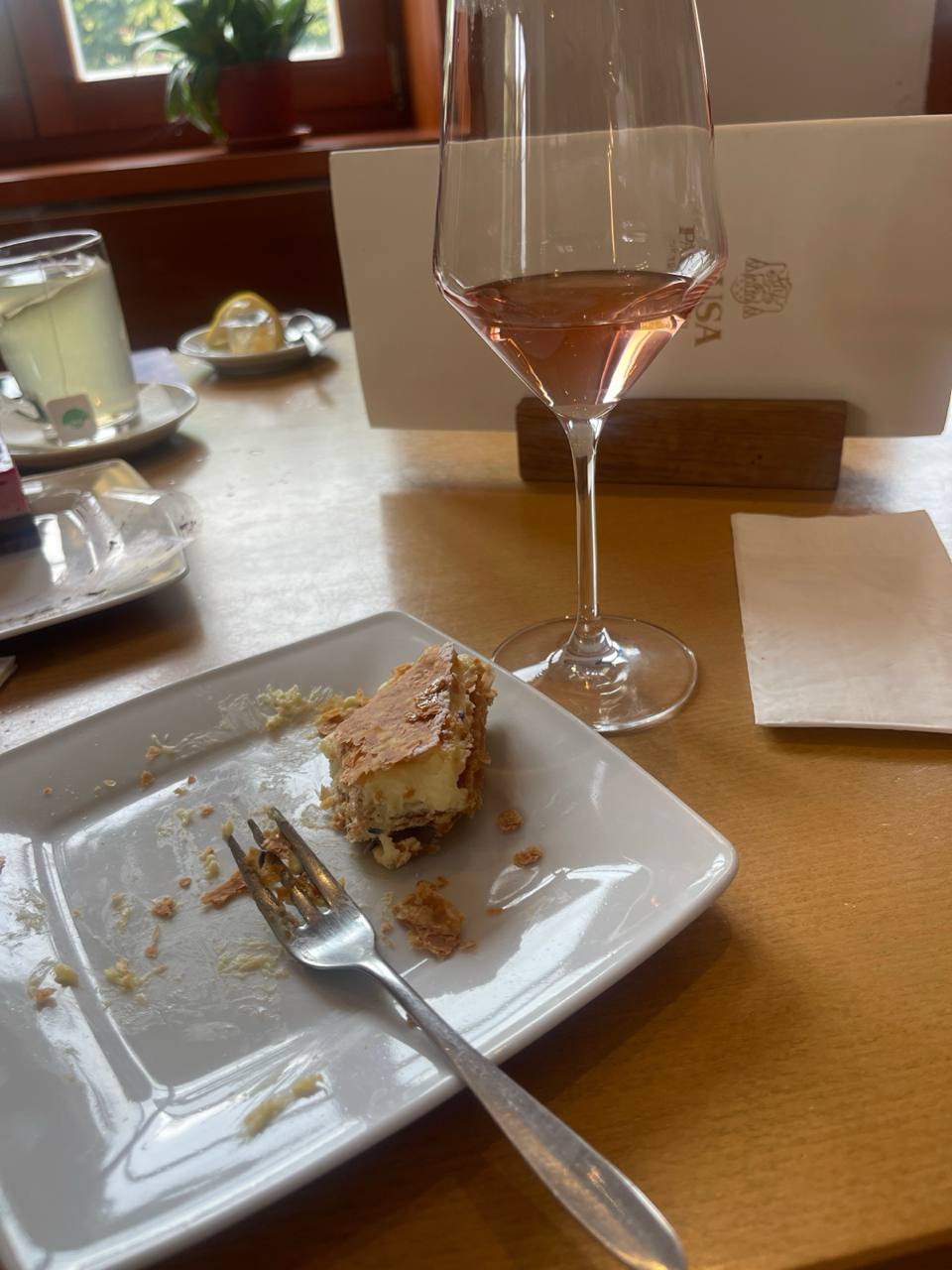
I had found the opposite vector from coffee.
Coffee generally encourages the impression that I might accomplish something. This encouraged a comfortable relationship with the possibility that I might not.
After a hill, a basilica, a cloister, a Roman inscription, a library, and several kings’ worth of documents, I felt I had assembled a reasonable case for sitting down.
The pastry was also persuasive.
On the way out, we passed the Millennium Memorial.
The information board explained the date: 1896, marking a thousand years since the Hungarian conquest of the Carpathian Basin. It had once carried a large copper replica of the Holy Crown above a much taller dome. Deterioration eventually required the dome’s removal, and the building took its present form.
Even a monument to a thousand years has maintenance issues.
The hill kept offering these different measures of time. Roman stone. Medieval charters. Later buildings. Memorials erected by people who were themselves already looking a thousand years backwards.
We were heading for a bus.
This seemed a manageable interval to concentrate on.
Then I saw the shell.
Oh, for fuck’s sake.
A yellow scallop shell on a blue ground. A waymarker. The Camino had found me again.
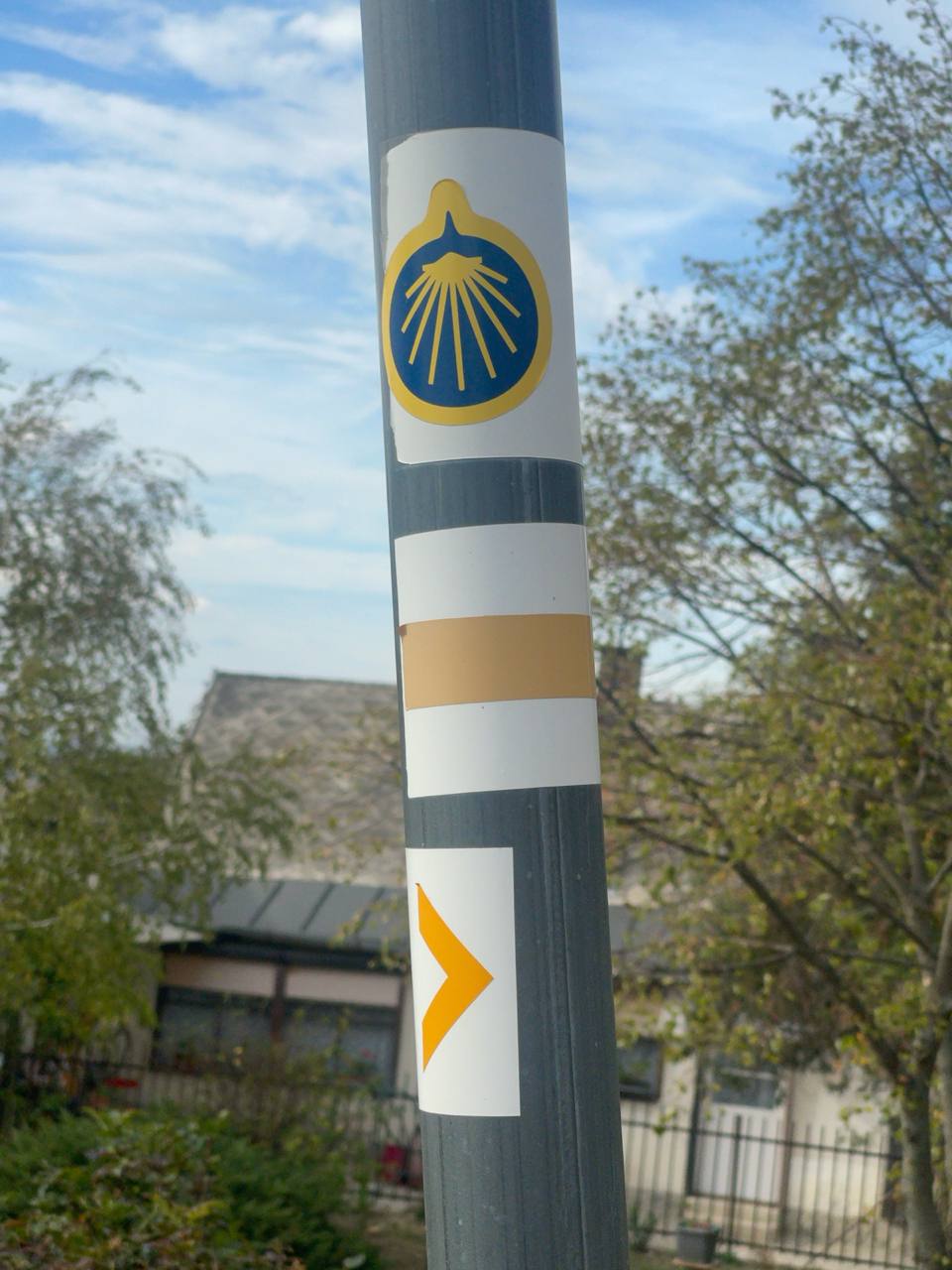
We had begun this European adventure in Santiago de Compostela and travelled away from it. I had already developed a fairly coherent theological explanation for what followed: reverse pilgrimage, offended saints, Madrid as corrective punishment.
I thought we had dealt with that.
I had endured Chamartín. I had reached Budapest. I had been grateful. Today I had even climbed a hill with the Stations of the Cross on it.
Apparently the file remained open.
The Hungarian Way of Saint James passes through Pannonhalma, connecting Budapest with places including Lébény and onward routes to the west. There was a perfectly sensible geographical reason for the marker to be here.
This did very little for the feeling that I was once again walking in the wrong direction under ecclesiastical observation.
I wanted to get on the bus before anybody in heaven might notice and decided that the balance of penance required a return to Madrid.
Perhaps someday I will do a Camino properly.
I would probably try to set a PR. See whether there was a Strava segment. Aim for a KOM
Take an ancient spiritual discipline intended to cultivate humility and ask whether anyone has a leaderboard.
Yes. I can see why the saints keep sending reminders.
Back in Győr, there was a telephone booth.
A strange box bearing the marks of a communications system from an earlier civilisation. I suggested it might be a teleportation device.
After the shell, I was cautious about the destination settings.
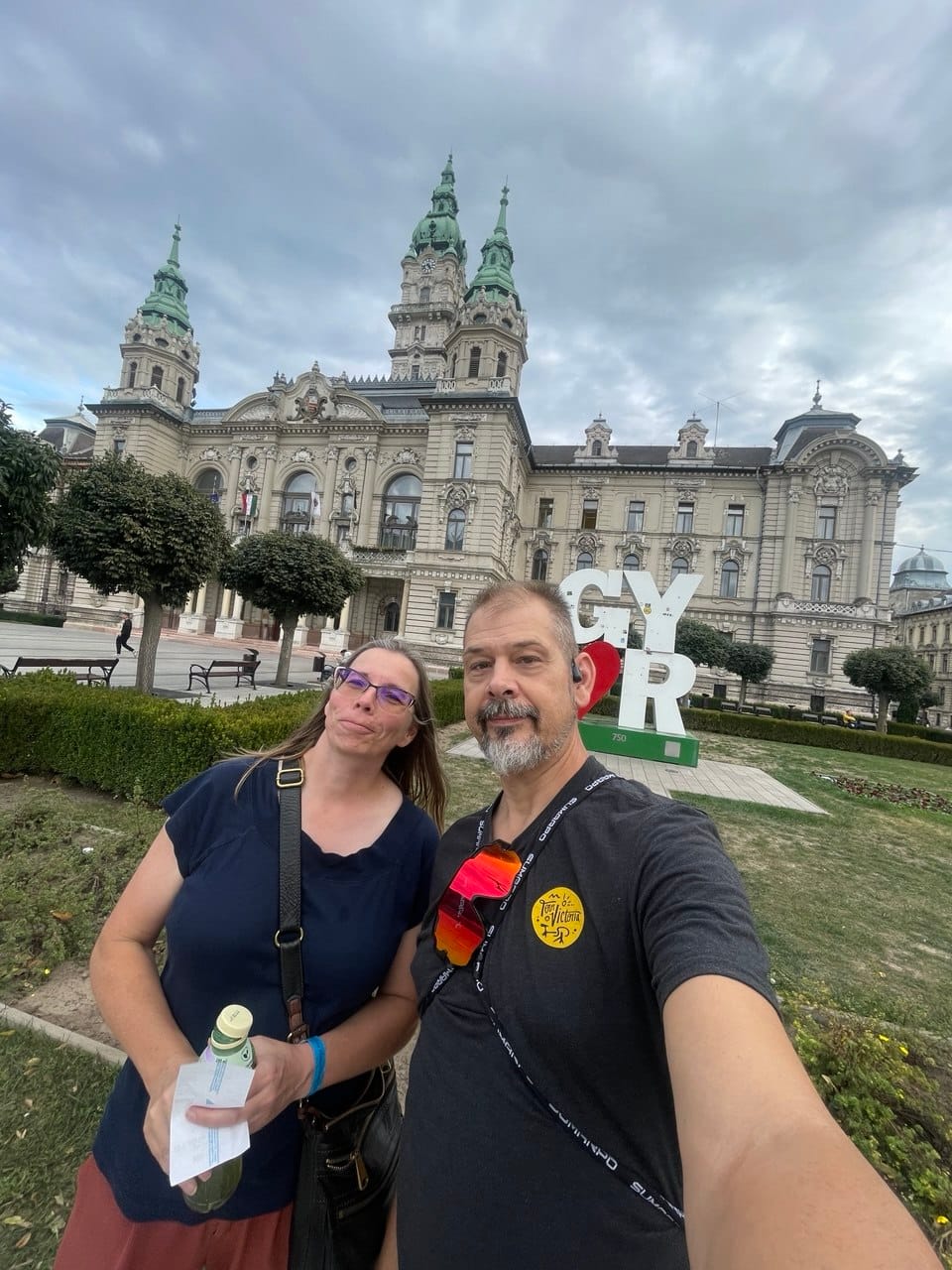
Carol and I took a photograph at the GYŐR sign. One of those ordinary pictures that gives the day a cheerful little full stop before the business of getting home resumes.
Then the railway introduced a timing puzzle.
We arrived fifteen or twenty minutes before the departure we thought we were aiming for, and the train we had expected to catch was already leaving.
I cannot provide a complete account of the discrepancy. I can report that being early did not, on this occasion, produce the advertised benefit, the saints fortunately had mercy and we jumped through the doors at the instant they were closing. We were not particular about which car of the train we had just jumped on.
Our seating assignment was something that could be worked out on the way.
My immediate travel advice was to arrive half an hour ahead. This was less a timetable recommendation than the reaction of a man watching a train exercise independence.
The abbey could preserve a document for nearly a thousand years. I was having difficulty preserving a twenty-minute advantage.
We did get back to Budapest.
And then, because the day had apparently not covered a sufficient range of human experience, we went looking for a ruin bar.
I had a vague idea of old underground spaces, and very little information that would have survived cross-examination. In the end, we selected a bar using a method that has served travellers for generations.
Shortest queue.
I bought a beer.
After a while, I noticed that the beer had developed rather more influence over the evening than I had anticipated.
It was a triple.
This clarified several things.
We had begun the day with Stations of the Cross and arrived, by a circuitous route, at a small personal lesson in moderation. The monks would probably have recognised the pattern sooner.
Fortunately, Carol remained in possession of the transport plan.
Bus-navigation designated driver. A role of considerable responsibility, even when somebody else is operating the bus.
Without her, I might have returned to Győr. Or continued to Debrecen. My confidence in being able to board public transport was, at that point, greater than my confidence in what would happen afterwards.
We got home safely.
When I think back over the day, the library is the room that stays.
All those books, returned to their shelves. All the work required for me to walk in, look around, and think how peaceful it was.
Pannonhalma gives you that impression of endurance, but the closer you look, the more hands you find in it. People building and rebuilding. Keeping a name legible. Putting a document somewhere safe. Saving a book. Continuing a practice because somebody before them believed it was worth continuing.
Yesterday had left me thinking about what people are capable of destroying.
Today I had spent a few hours among things they had taken the trouble to keep.
Then I drank wine, misjudged a beer, and depended on Carol to get me home.
The spiritual development remains a work in progress.
But for a while, on that hill, I managed to be still.