Budapest: Day Five, Pain and Pleasure
Budapest: Day Five, Pain and Pleasure
The House of Terror, a necessary coffee, and the woman who brought the right kind of darkness to Budapest: liquorice.
We had planned to visit the House of Terror and then a Swedish candy shop.
On paper, this looked like an itinerary assembled by two people who had stopped communicating halfway through.
By the end of the afternoon, it would turn out to be unusually good planning.
The day began on the 30A, heading towards the M1 and Oktogon. Budapest continued its rather endearing habit of having public transport that took us to places.
I have started calling the underground pedestrian crossings “rat holes.” This is residual Madrid damage. Hungary should not take it personally. There is a difference between briefly going beneath a road and discovering that your afternoon has been requisitioned by the Madrid Ministry of Tunnels.
On the metro, I noticed the leather hand straps.
There is a certain bougieness to leather as a utility item on a subway. You are standing up, going somewhere ordinary, holding something that could reasonably have been sold to you as an accessory.
I was still in that part of the day. Looking at details. Making small jokes. Taking photographs.
Outside the museum stood the Iron Curtain memorial, heavy chains and the dates 1949–1989.
Then we went inside.
Sixty Andrássy út is a street address.
That is one of the things that gets to you.
People can write it on an envelope. You can walk past it on your way somewhere else. The city carries on around it, with pavements and traffic and perfectly ordinary reasons for being late.
The building housed the Hungarian Arrow Cross and, after the war, the communist political police. The basement prison’s own explanatory panel describes that succession. Different men acquired the authority to decide who went downstairs.
The address remained useful.
The early rooms took us through occupation, collaboration, and war. I had to straighten out the sequence as I went. Hungary entered the war against the Soviet Union in 1941 as Germany’s ally. German occupation came in March 1944; the Arrow Cross took power that October. Hungarian authorities had already enacted antisemitic measures, and Hungarian officials participated in the deportations. The Arrow Cross subsequently terrorised Budapest’s Jews, including murdering people at the Danube.
There were local perpetrators here, too. Men who knew the streets and spoke the language.
That matters when you are walking through a city because it feels like home. Affection does not make its history comfortable. Sometimes it brings the history closer.
I had spent the last few days admiring that river.
Now I was reading about people being shot into it.
In the Gulag room, one date stopped me: 2000.
András Toma came home in 2000.
The museum records his return at seventy-four. A Hungarian prisoner of war, he had spent decades in a Russian psychiatric hospital before returning to Hungary. Contemporary reporting described his homecoming.
Two thousand.
That is a date I can put things beside. My own life. Things I was doing. Already married for 3 years at that point. A world busily congratulating itself on having entered a new millennium.
A man was still finding his way home from the Second World War. It caused me to stop, just to take that in for a moment.
We like historical periods to finish cleanly. A surrender. A wall coming down. A flag lowered. These are useful markers for a textbook, and very poor guarantees that everyone has been accounted for.
Somewhere beyond the ceremony, someone is still missing.
There is a room called Changing Clothes.
The museum uses it to show the transition between dictatorships, including Arrow Cross members who found places in the communist apparatus. A change of uniform could accommodate a remarkable continuity of occupation.
It is an unsettlingly domestic name for a room about that.
Changing clothes is what you do before dinner.
My mind went to the smaller changes that make the larger ones possible. The person who discovers that a conviction is negotiable. The neighbour who decides it would be safer to report someone. The official who can see exactly what is happening and signs anyway.
Fear does not have to arrive as pain. The prospect can do considerable work in advance.
You can imagine the knock, the loss of your job, the consequences for your children. You can rehearse the disaster until almost any accommodation begins to feel like common sense.
And thus they slip from the clothes of neighbour to informant.
That was the thought i sat with in the museum.
It is the one I keep coming back to.
The surveillance equipment looks old enough to invite a little technological condescension.
A rotary telephone. Tape machines. Consoles. A desk with a typewriter. Devices whose operation required somebody to sit there and do the work.
Then you remember what the work was.
A telephone does not have to be advanced to ruin a life. A filing cabinet can hold enough information to get someone killed. These people managed perfectly well with machinery we would now consider painfully inconvenient.
I work with technology. Looking at this equipment, I could not avoid thinking about how much of its labour can now be automated. Listening. Transcribing. Searching. Connecting a name to another name. Finding the same face in a different place.
The old apparatus needed rooms of people. Modern systems can remove much of that friction.
The operator still supplies the purpose.
This is where the museum followed me back to the airport through which we had entered Europe.
In Germany, we had been required to provide biometrics, including fingerprints. I found it profoundly offensive. In my own mental vocabulary, fingerprinting belonged to being processed as a suspect. Having it made a condition of entering a country felt like an accusation delivered by a machine that had no interest in my objection.
The relevant system is the EU’s Entry/Exit System, or EES. It records eligible short-stay travellers’ border crossings and biometric information. Its stated purposes include identifying overstays and combating identity fraud.
I understand the explanation.
I want the next explanation as well: who can use the information, how that use is constrained, and what happens when the people making those decisions change.
As far as I am concerned, handing over my fingerprints is a permanent surrender of something I cannot change. They have the record. I have an assurance about what will happen to it.
The system has stated retention limits. A rule on a page is no guarantee that every copy will disappear, that the rule will remain unchanged, or that whoever inherits the system will respect it.
European Digital Rights raised objections to this collection of biometric information years before the system opened, including concerns about proportionality, access, and the risks to fundamental rights. The question did not begin with an irritated Canadian at a fingerprint scanner.
A fingerprint is an awkward thing to surrender because, should it escape the conditions under which you supplied it, you cannot request a replacement finger. Passwords at least offer that small administrative consolation.
The museum had just shown me an address passing from the Arrow Cross to the communist political police. Institutions can change hands. Records can be seized, retained, repurposed. The next authority does not have to ask everyone to register again if a useful collection already exists.
That is the risk I am talking about. Whoever collects the information today cannot promise me the character of everyone who might possess it tomorrow.
I do not find “we have a policy” an adequate answer to that.
Europe has ample reason to think carefully about the records it creates.
Canada came into the room with me, too.
It would have been a more restful visit if I could have kept it out.
I see patterns that worry me: the expansion of identification, the ease with which dissent becomes a label, the appetite for asking ordinary people to monitor one another. I feel Canada is moving in a direction we should be resisting much earlier and much more firmly than we are.
The online age-checking proposals are one example. The broad social-media proposal is Bill C-34, the Safe Social Media Act. As proposed, it includes age-verification or age-estimation requirements for specified social-media services to keep under-sixteens from holding accounts, alongside measures concerning access to pornography.
The text promises limits on the use of personal information and its destruction after verification.
My concern is how much identifying machinery will be built to satisfy the requirement, how it will work in practice, and how difficult anonymous participation could become. OpenMedia raises related objections about privacy, compulsory age checks, and the independence of the proposed regulator.
The Canadian Civil Liberties Association also warns that the bill’s breadth invites over-compliance at the expense of privacy and expression. These concerns deserve to be answered on their merits. A government calling its legislation safe is telling us what it wants us to think of the legislation.
And the risk already has a recent example.
In September, Brian Krebs investigated a dark-web marketplace advertising more than 153 million American and Canadian driving-licence records. He found his own licence and checked other individual records, tracing evidence towards IDScan.net. The advertised total was the seller’s figure, not an independently audited victim count. IDScan.net subsequently acknowledged unauthorised access to part of its cloud environment.
This was an identity-verification business serving purposes including age checks and car rentals. Information people surrendered to establish that they were legitimate customers had become merchandise for people with rather different intentions.
There is another question hiding inside “we delete your ID.” What, exactly, gets deleted? The photograph? The name and date of birth extracted from it? A link between your legal identity and an account? Logs, backups, information sent to another processor?
Deleting one image does not establish that all of those have gone. That requires its own rules, implementation, and evidence. And once a thief has a copy, the company’s retention schedule is a document belonging to somebody else.
The thief is unlikely to attend the compliance meeting.
This is why I object to collecting the information in the first place. Every unnecessary copy creates another place from which it can escape. Every connection made with it can outlast the reason we were given for making it.
Protecting children is a worthy purpose. It also deserves a design that survives questions about power, access, and abuse. “Think of the children” should begin that discussion. Too often it is offered as permission to end it.
I want systems that collect as little as possible. I want constraints that hold when someone unpleasant is in charge. A promise of responsible management is a thin thing to stand between a person and a database.
The pandemic left another set of memories. Families kept apart. Gatherings restricted. The speed with which asking a question could get a person placed in a category and dismissed.
The reporting machinery was real: Toronto’s own 2020 account records 311 taking complaints and enforcement requests about COVID emergency orders.
What stays with me is the social permission that came with it. Looking at other people’s ordinary connections as potential violations. The ease with which suspicion could be presented as civic virtue.
A society can have a public-health emergency and still owe an account of what its response did to trust. I remain angry about that part of Canada’s response, and about how readily that anger is treated as evidence that the person feeling it should not be heard.
In the propaganda displays, I thought of CBC and CTV: the familiar tone of certainty, the framing that tells an audience who deserves its suspicion. That is my judgement about habits of coverage. I want journalism that makes power explain itself, especially when the official explanation arrives already wrapped in moral superiority.
The future I fear is one in which these habits become normal enough that the next expansion of control barely registers.
I cannot give that future a date. I can say that I do not want to wait for something irreversible before being permitted to object.
The church room had a cross set into the floor, light rising through it, a vestment displayed beyond.
The history behind it includes clergy removed, imprisoned, tortured, and killed. Cardinal József Mindszenty’s persecution is part of that story. Religious institutions represented loyalties the regime could not comfortably leave outside its control.
Again, I thought of Canada. Of restrictions on worship. Of churches burning. Of how little confidence I have that the loss of a Christian place of worship receives the sustained moral attention it deserves.
The pandemic restrictions covered other faiths as well; the contemporary guidance explicitly included synagogues, mosques, gurdwaras, and temples. And police have investigated church fires but no one has ever been investigated or charged. In fact I'm not aware of a single RCMP investigation into the burning of churches.
I still want to hear a clear, unqualified insistence that people’s places of worship deserve protection. Criticise an institution. Investigate it. Prosecute wrongdoing. The people who gather there should be able to do so without feeling that their grief has become politically inconvenient.
That room made the question of belonging feel very immediate: what happens when a government regards a community’s independent loyalties as a problem to be managed?
The deportation exhibits were closer to home again.
In the history handed down in my family, there are relatives who were deported and relatives killed in the region around Novi Sad. I carried that history into this room.
Reading about confiscation and expulsion when those things sit inside your family’s history has a different weight. You start supplying the ordinary possessions that the official words leave out. The furniture. The tools. The things somebody thought they would hand down.
The museum brings several histories together. The expulsion of ethnic Germans after the war and the later internal deportations were distinct campaigns. The 1951 removals from Budapest forced thousands of families out of their homes.
The label tells the state what to do with you. It can be an ethnicity, a class, a previous occupation, a relationship to the wrong person.
Once the label is doing the work, your actual life becomes inconvenient detail.
Then came a room lined with what looked like one-kilogram bricks of lard.
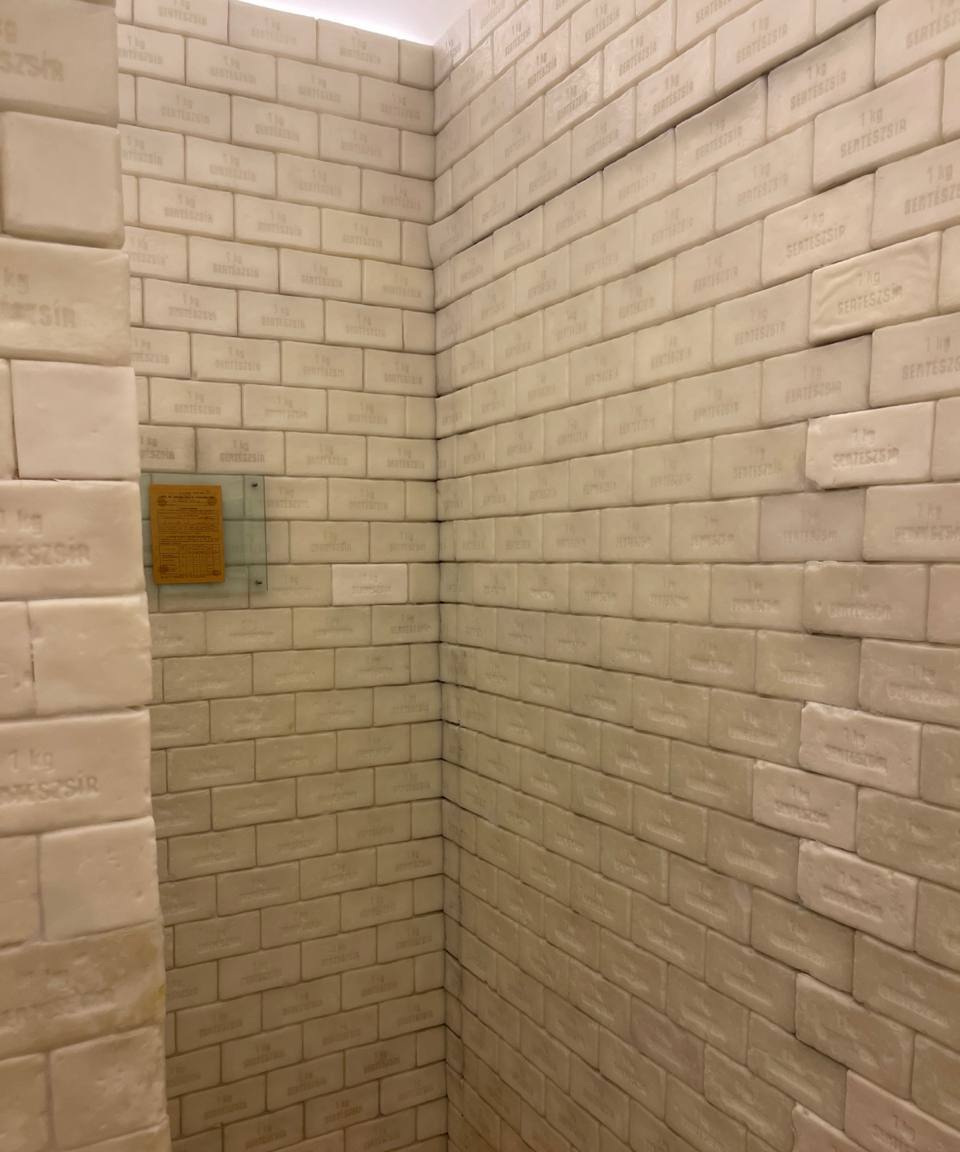
The room of compulsory deliveries deals with the persecution of farmers and the extraction of their produce. Kulák: a word that could turn a farmer into a class enemy.
The installation gives the abstraction a material you understand.
Food.
Something stored because winter happens. Something a household needs. Something produced through work, then placed within reach of a state that has decided your claim to it is morally defective.
There were propaganda posters on those walls as well. The taking came with instructions about how enthusiastically it should be received.
And then the basement.
The prison spaces are reconstructed. The museum’s panel says the reconstruction relied on survivors’ recollections after the original traces had been altered or erased. That makes the testimony behind them more important, not less.
A standing cell. A wet cell. A space too low to stand upright.
Dimensions deliberately chosen to make a body suffer.
I kept thinking about the people who had worked out those dimensions. Somebody knew what would hurt. Somebody arranged for it. Somebody brought the next person in.
The execution display brought another realisation: the killing described here could be strangulation, without even the swift broken neck people associate with a long-drop hanging.
“Not even the civility of a broken neck, just cold asphyxiation” I recorded in my notes.
It is a terrible sentence to find yourself saying. More terrible that, in the moment, the distinction matters.
Above us was a city street.
That stayed with me almost as much as the cells. How near ordinary life could be. How little distance there needed to be between someone walking to an appointment and someone wondering whether they would ever leave a room.
The uprising began on 23 October 1956. The decisive Soviet invasion came on 4 November.
For a brief period, people had made another future seem possible. Then came the tanks, the defeat, and the reprisals. I reflected on another event in the cold of january and February of 2022 in Canada. Not even in the same postal code as what happened in 1956, however this sort of thing should not even be allowed on the same planetary body.
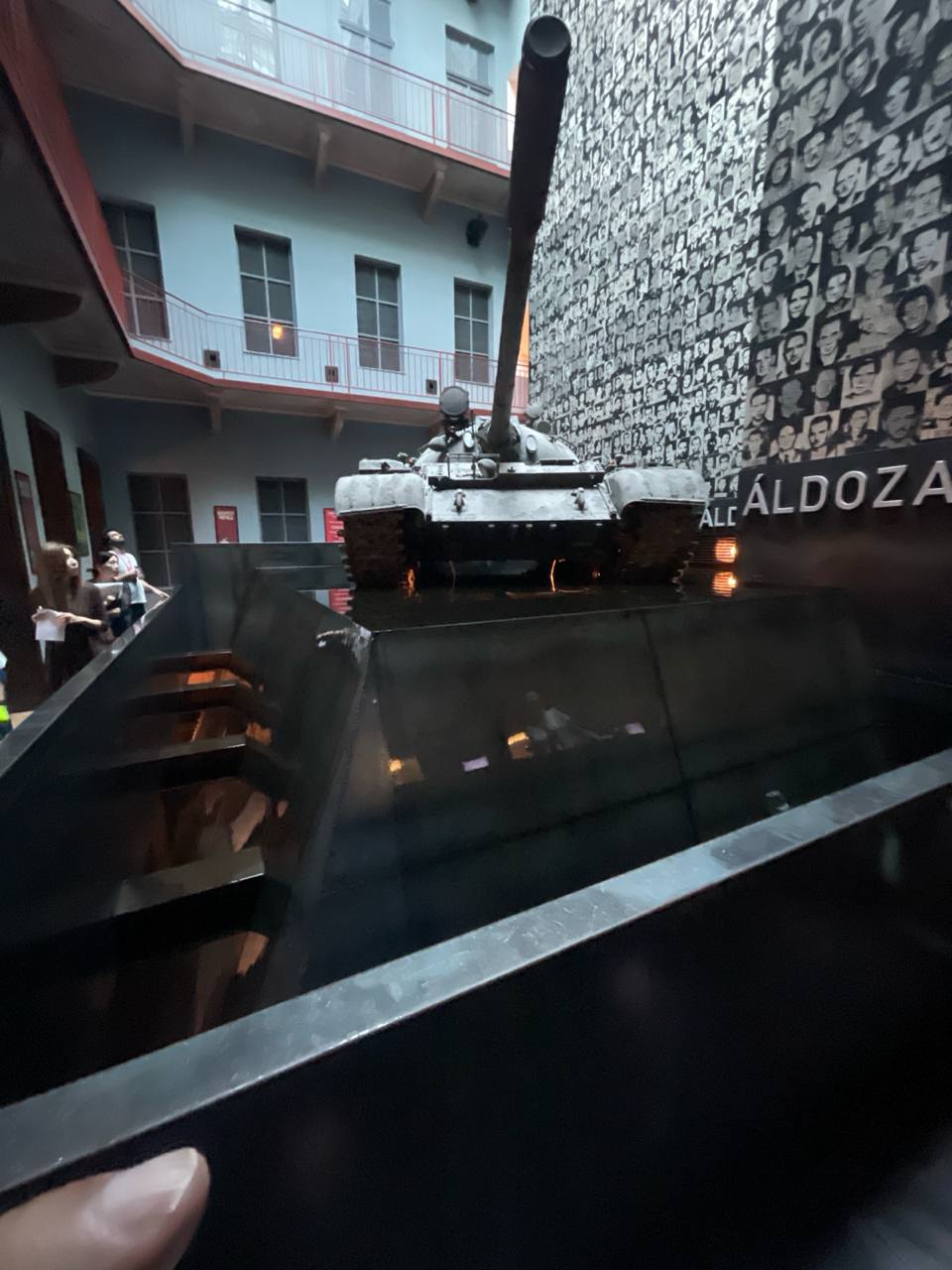
In the museum’s courtyard, a Soviet tank stands beside a wall of victims’ portraits.
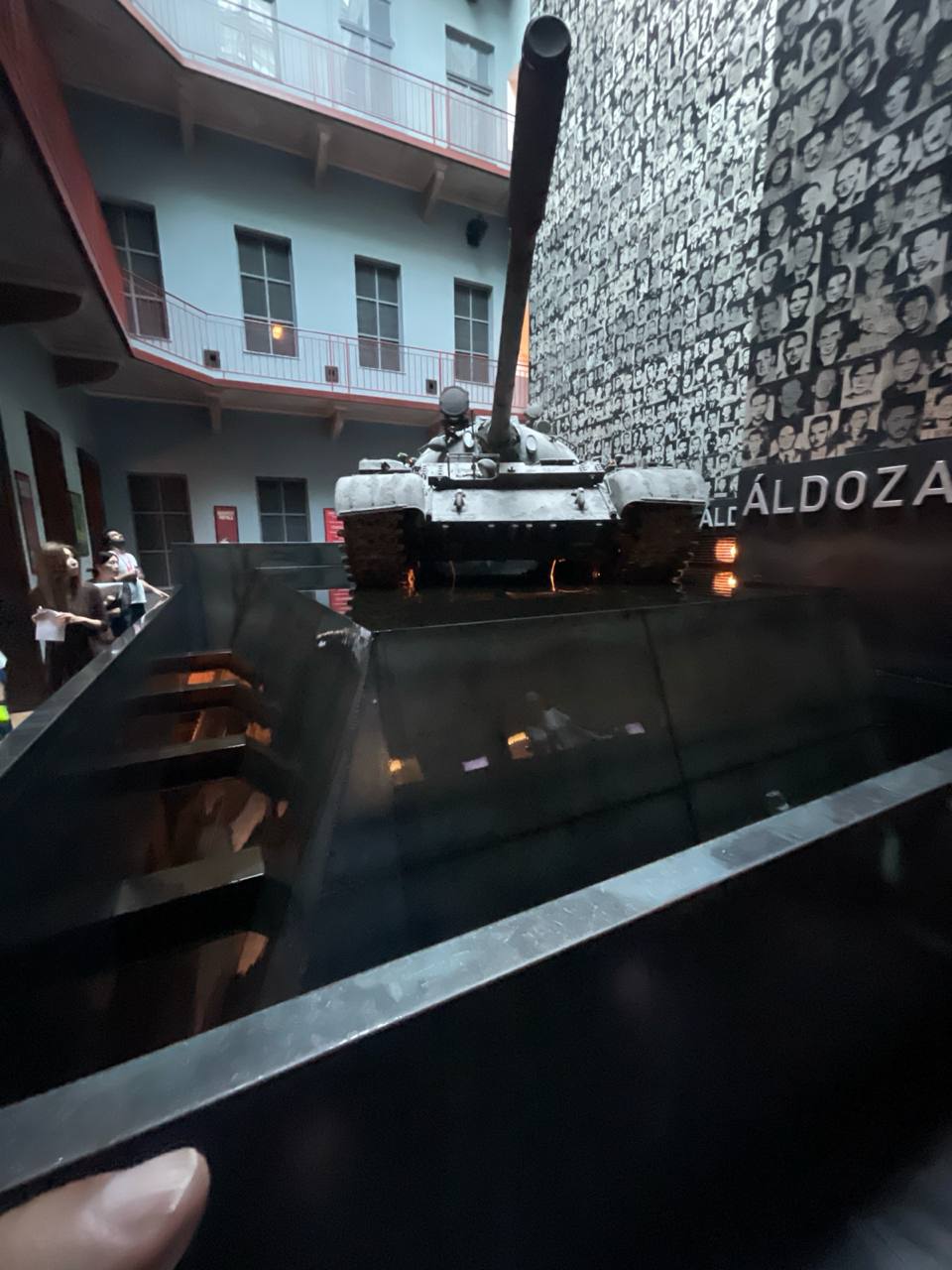
Faces and armour.
The machine occupies an enormous amount of space. Each face occupies very little. Your eye keeps moving between them, trying to hold the scale of both.
Three hours, roughly.
We had been inside for about three hours.
When Carol and I came out, we were both a little shell-shocked.
I needed coffee.
I needed to stop taking things in. To put something warm and ordinary between myself and what we had just seen, and give my mind a chance to find somewhere to put it.
The original plan had always included the Swedish sweet shop. That pairing now felt almost prophetic. Whoever had arranged our afternoon had, apparently, anticipated a need for emergency confectionery.
But coffee came first.
There is a stage after an experience like that when your feet have left the building and the rest of you has not quite followed. The street is there. People are doing ordinary things. You can see them, but your attention is still below ground.
I know enough about my own neurodivergent mind to recognise when I need to consciously take care of it. I cannot simply order myself to switch subjects because the next item on the itinerary has arrived.
The pause mattered. So did choosing something gentle afterwards.
In my notes, I called it brain bleach. A crude phrase for a very real need: to make room in my head for something other than what people can do to one another.
Eventually, we were ready to go and find Sofia.
Hungary has a liquorice problem.
I offer this with affection, and with the admission that my fieldwork consisted of repeatedly failing to find the liquorice I wanted.
Still. This is a country with centuries of history. Empires have arrived, rearranged things, and left. Trade has passed through. Recipes have travelled. Entire architectural styles have made themselves comfortable.
Somehow I could obtain a life-size marzipan footballer more easily than a satisfactory bag of liquorice.
There are omissions in the historical record that deserve attention.
The solution turned out to be Poppy, a Swedish candy shop on Rumbach Sebestyén utca 15b.
Poppy’s, as it had become in my notes. The place we had been looking for.
Pink walls. Clear bins. Rows of sweets. A room arranged around the entirely reasonable proposition that you might like something nice.
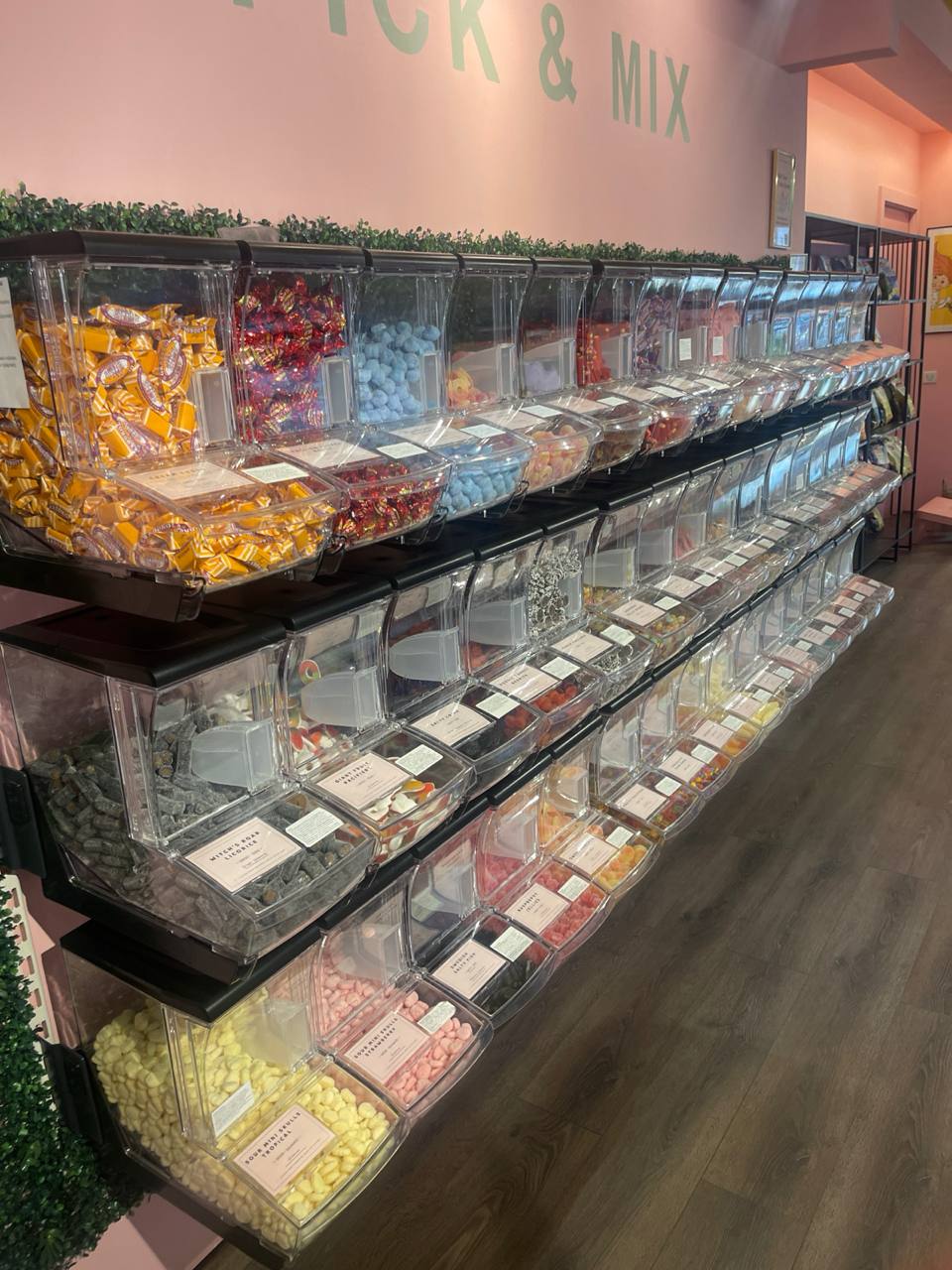
Sofia, the owner, told me she had run into the same problem. She had come to Budapest to work less, and could not find the good liquorice she wanted. In ended up starting the store as a new project and ended up working more.
Yea... same trap I've fallen for. "Oh ill get into Triathlon, just for the fun..." -> national team athlete.
I generally complain about these things. Sofia had secured premises and stock. A more effective approach, admittedly, though mine requires less inventory.
A profile of the shop identifies her as Sofia Andreasson and describes the Swedish sweet tradition she and her partner wanted to bring with them. I understood the impulse immediately. You can love the place you have moved to and still want one particular taste from somewhere else.
The store offers more than ninety pick-and-mix sweets. This is an excellent number. Large enough to require consideration, small enough that consideration can plausibly continue in person.
And then there was the soft serve with liquorice topping.
Oh.
Yes.
Cold, soft, sweet, with that liquorice flavour I had been looking for. I was in heaven for every second of it. After an afternoon in which I had struggled to know what to do with my attention, it had found a task it could complete happily.
Eat this.
Appreciate this.
Possibly arrange more of this. Dear reader, if you find yourself overwhelmed in Budapest needing a reset and a sweet fix, go here. This is a monastery to the religion of licorice.
I hesitated over putting Sofia’s shop in the same article as the House of Terror.
She deserves to be found by people having an entirely pleasant day as well. People whose most serious problem is choosing a sweet. Go for the liquorice. Go for the soft serve. Go because someone missed a small pleasure enough to build a place where other people could find it.
For me, on this particular day, that small pleasure did a great deal.
I could feel my attention returning to the room I was actually in. The colours. The choices. A conversation with someone who had made something good. The immediate, uncomplicated fact that I was enjoying myself.
There was no betrayal in that enjoyment. I had taken the museum seriously. I would carry it with me. I also needed to be able to carry on with the afternoon.
Sofia had given me somewhere to do that.
On the way home, I was considering a ride along the Danube. It was getting late; I did not know whether I could make it work.
The thought itself felt welcome. My mind had reached the point where a bicycle and a river could become possibilities again.
Budapest had shown us something dreadful and then, a little later, offered a place to recover our balance.
I thought about what home asks of you. To know something of what happened there. To let that knowledge disturb you. To keep looking closely, including at the things you would rather dismiss because you love the place.
And to live there, too. To buy coffee. To talk to someone. To discover that the thing you had been missing is available a few streets away because somebody else missed it first.
The museum stayed with me.
So did the kindness of the afternoon that followed.
I went home carrying both.