Szentendre: The Greenish-Tan Danube
Szentendre: The Greenish-Tan Danube
Day four. A train to the end of the line, a footballer made of almonds, and a modest charge for being human.
Yesterday I went north along the Danube on a bicycle and ended up having a rather substantial conversation with my ancestry.
Today we took the train.
This seemed less likely to involve Garmin, and therefore offered a reasonable prospect of peace.
The destination was Szentendre, north of Budapest, on the other side of the river from yesterday’s expedition to Göd. We took the H5 to the end of the line. There is something reassuring about a destination beyond which the train cannot go. It removes one category of personal failure from the itinerary.
We arrived at a station, a Spar, and a few shops.
I had been expecting charm. Initially, Hungary offered groceries.
This is apparently how Szentendre works. It allows you to arrive without making a fuss, then leaves you to find the beautiful bit yourself. Walk a little. Cross watercourse I had provisionally classified as a canal. Keep going.
Then the town opens.
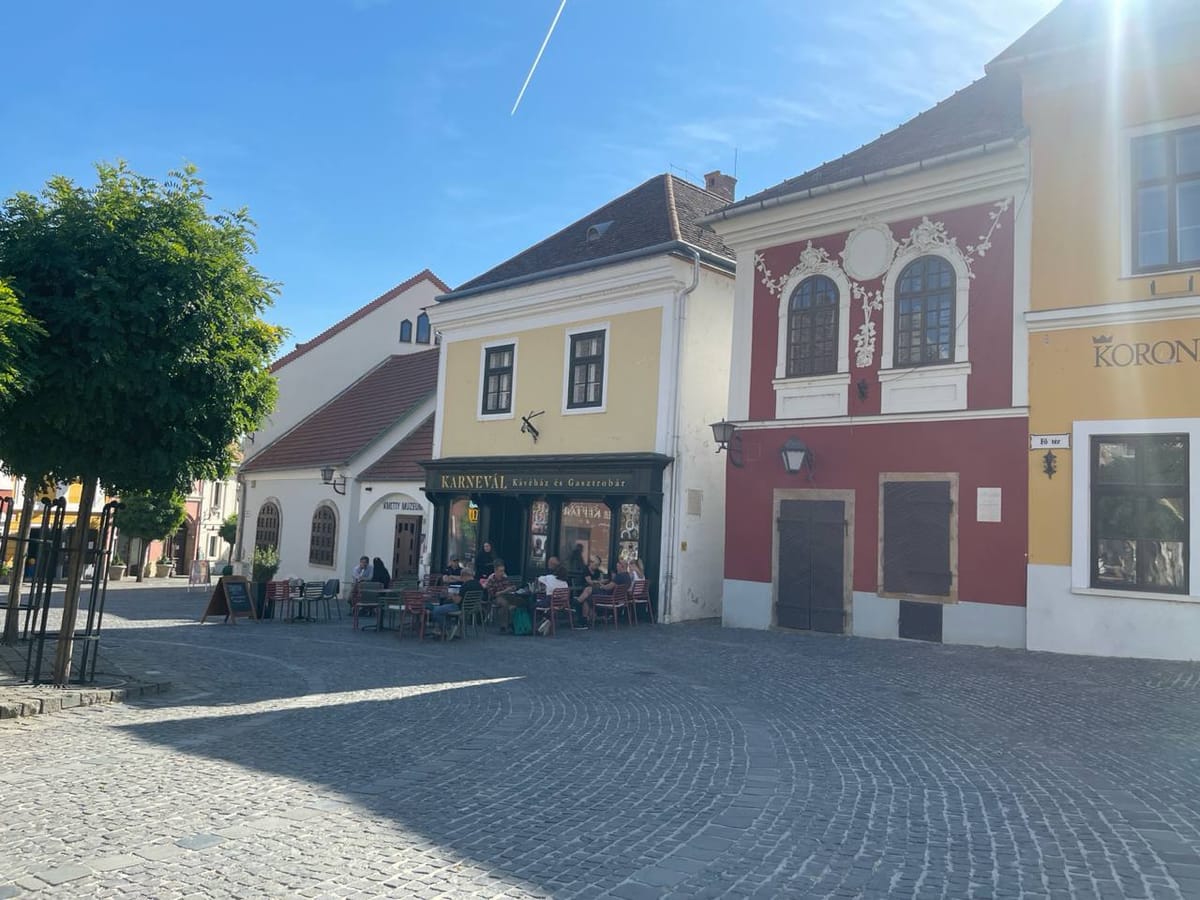
Cobblestones. Warm plaster. Red tiles. A roofline doing something you weren’t expecting. Streets narrowing and turning out of sight, with just enough visible around the corner to interfere with any plan to walk straight through.
Ah.
There you are.
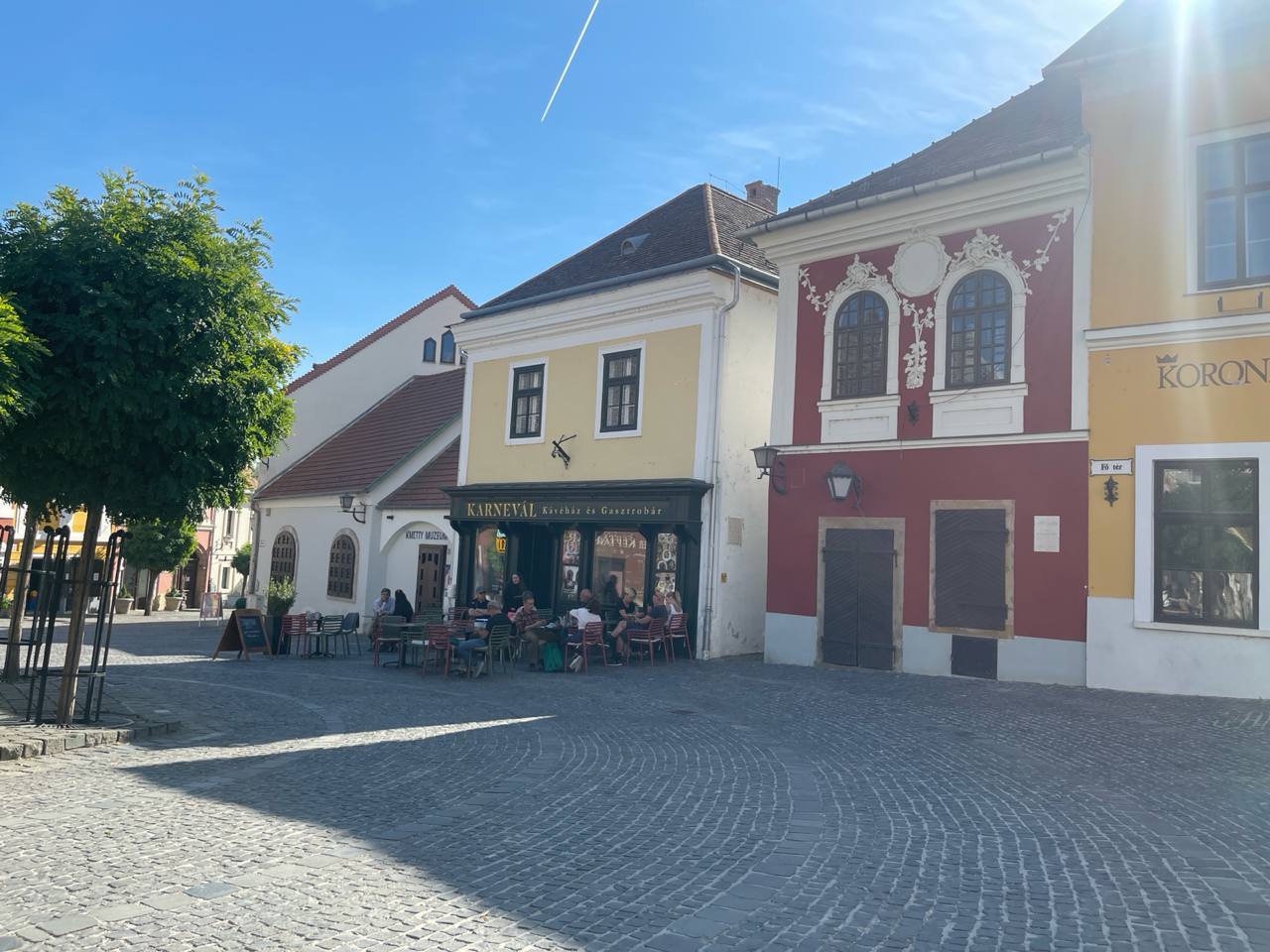
The town keeps this part a short walk beyond the supermarket.
I ordered an Americano with a little cream, to go.
In Hungarian.
I feel this deserves its own paragraph. Hungarian is a language in which a modest request can look, to an outsider, like the name of a particularly ambitious pharmaceutical. Getting a cup of coffee at the end of a sentence you assembled yourself is a small but meaningful achievement.
And it was good coffee. Finally.
My requirements for my chosen addiction were being met at a rate that would have caused serious institutional concern in Madrid.
Coffee in hand, I could get on with looking at things.
The town has a different feel from Budapest. Smaller, obviously, but also different in its proportions and its turns. There are Serbian signs and Cyrillic inscriptions, church towers above the roofs, little passages between buildings. Something Balkan and Mediterranean in the way it all fits together. You notice it before you know enough history to explain it.
Then you look up the history and discover that the feeling has a reason.
Szentendre’s own account of its past connects much of this character to Serbian, Dalmatian, and Greek settlers, with a major arrival in 1690 under Patriarch Arsenije III Čarnojević. The town had been devastated during the Ottoman period and the wars surrounding it. The people who came helped build it again, making lives through trade, crafts, and wine.
That puts a little weight beneath the pretty façades.
Somebody arrived here needing a place to live. Somebody built a house, opened a shop, found a way to feed a family. Generations later, I am standing outside with an Americano, admiring the roof.
Tourism is sometimes a very delayed thank-you to people who had considerably more pressing concerns.
There is a marzipan museum.
Of course there is.
Once a town has established that it can do architecture, history, and coffee, the natural next step is a life-size footballer made from confectionery.
The footballer is Ferenc Puskás. Hungarian legend. Real Madrid legend, which means Madrid has managed to make an appearance in my day despite being several countries away and very firmly on my list.
I will allow Puskás. My quarrel is with the transport system.
The town’s report on the sculpture says it was unveiled for the Szamos Marzipan Museum’s thirtieth anniversary in 2024. Its creator, Tünde Kimmelné Izsák, spent 304 hours on it, using eighteen kilograms of marzipan and coconut.
Three hundred and four hours.
I admire the commitment. I also admire the restraint required to work with eighteen kilograms of marzipan for that long and still have a footballer at the end.
Bronze would have been the conventional choice. It has certain advantages outdoors and attracts fewer ants. But there is something rather lovely about commemorating sporting greatness in a material normally found inside a cake. A national hero, rendered with skill, affection, and a clear understanding that almonds deserve a larger role in public life.
A little further on, Teyföl had Michelin plaques beside the entrance, dated 2024 and 2025. It is listed in the Michelin Guide; the name means sour cream.
A restaurant called Sour Cream, in a handsome old building on a cobbled street, with Michelin paying attention.
Hungary remains very comfortable with itself.
I rather like that.
Walking here involves a series of minor negotiations with your attention.
You intend to go somewhere. A staircase appears. There is ivy on a wall, a blue door below, an arch beyond which you cannot quite see. Your original destination becomes an administrative detail.
We went down the steps and through a narrow passage, brick on one side, pale plaster on the other, a lantern overhead. There were air-conditioning units, utility covers, a bit of graffiti. The practical equipment of a town that has continued living inside its own good looks.
The whole descent had a Mediterranean feel. Cool shade between close walls, light at the far end, the sense that another small piece of the place would reveal itself as soon as you reached the bottom.
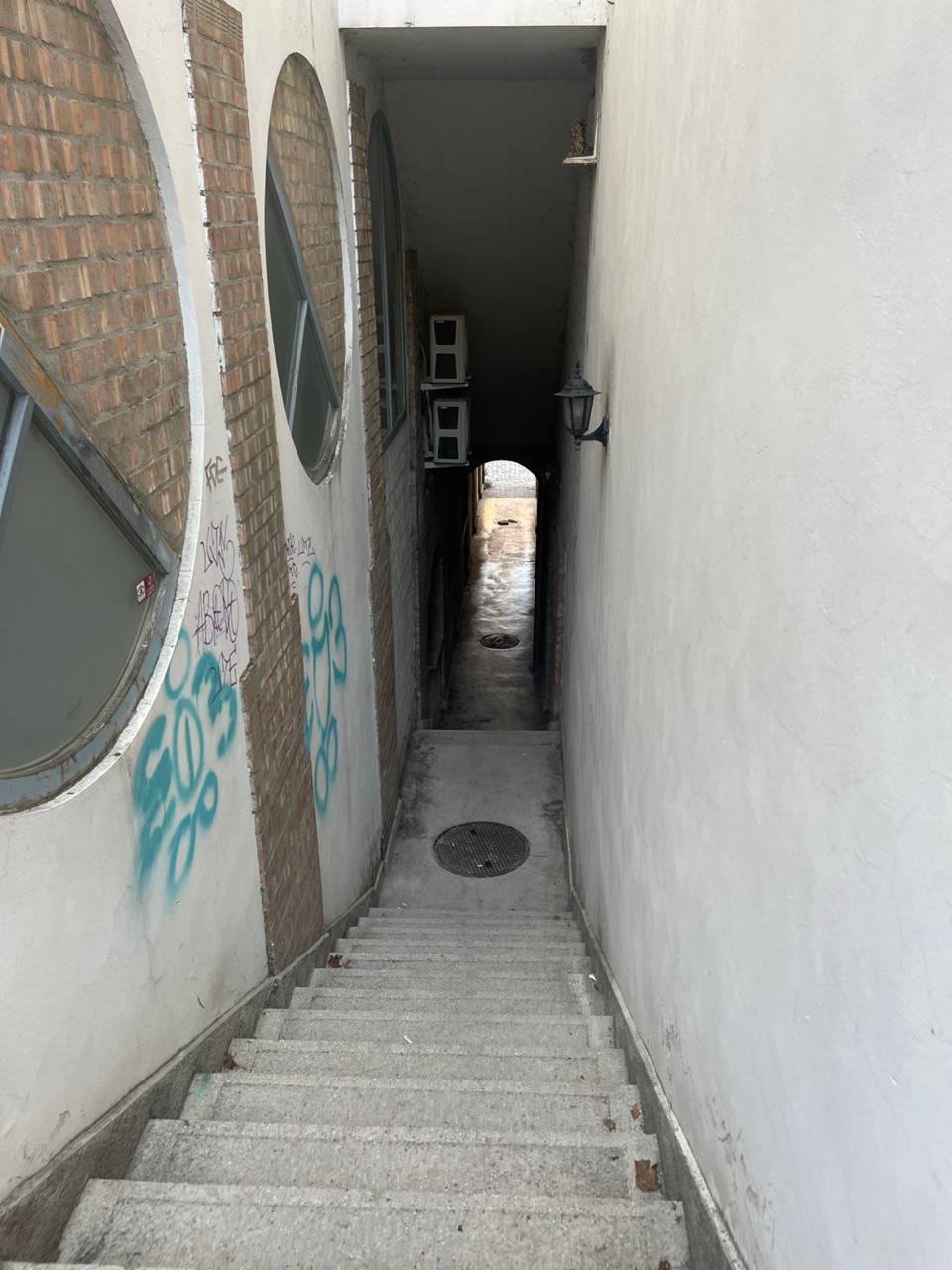
A perfectly acceptable reason to lose track of where you were going.
I am recovering my ability to enjoy a passageway.
This may sound like a low bar. After Chamartín, it represents considerable progress.
There were road signs requiring translation, too. A no-entry sign, with a bicycle beneath it and the word KIVÉVE.
Except.
No entry, except bicycles.
Once you have the word, the sign becomes entirely reasonable. Until then, it looks like two parts of the traffic department have failed to agree.
I like these small acquisitions. One word learned over coffee. Another beside a street. Gradually the place becomes easier to read. You still sound foreign, and occasionally ask for something with the grammatical confidence of a dropped cutlery drawer, but a little more of the world opens each time.
Up above the lanes, an ornate iron cross stood on a weathered stone pillar. Cyrillic lettering. The date 1901. Roofs and a church tower beyond it.
I took photographs.
There are details you photograph because they are beautiful, and details you photograph because you suspect you will want to understand them later. This was both.
Eventually, the river.
The Blue Danube.
An attractive title. Strong recognition. Excellent career in concert halls.
The river itself was taking a more flexible approach to the colour specification. Green in one direction, teal in another, a suggestion of tan where the light and water felt like collaborating. Across it, autumn trees were getting on with gold and brown. A white boat sat moored near the bank.
Perfectly beautiful. A little awkward for Strauss.
“The Greenish-Tan Danube” would have sold fewer concert tickets.
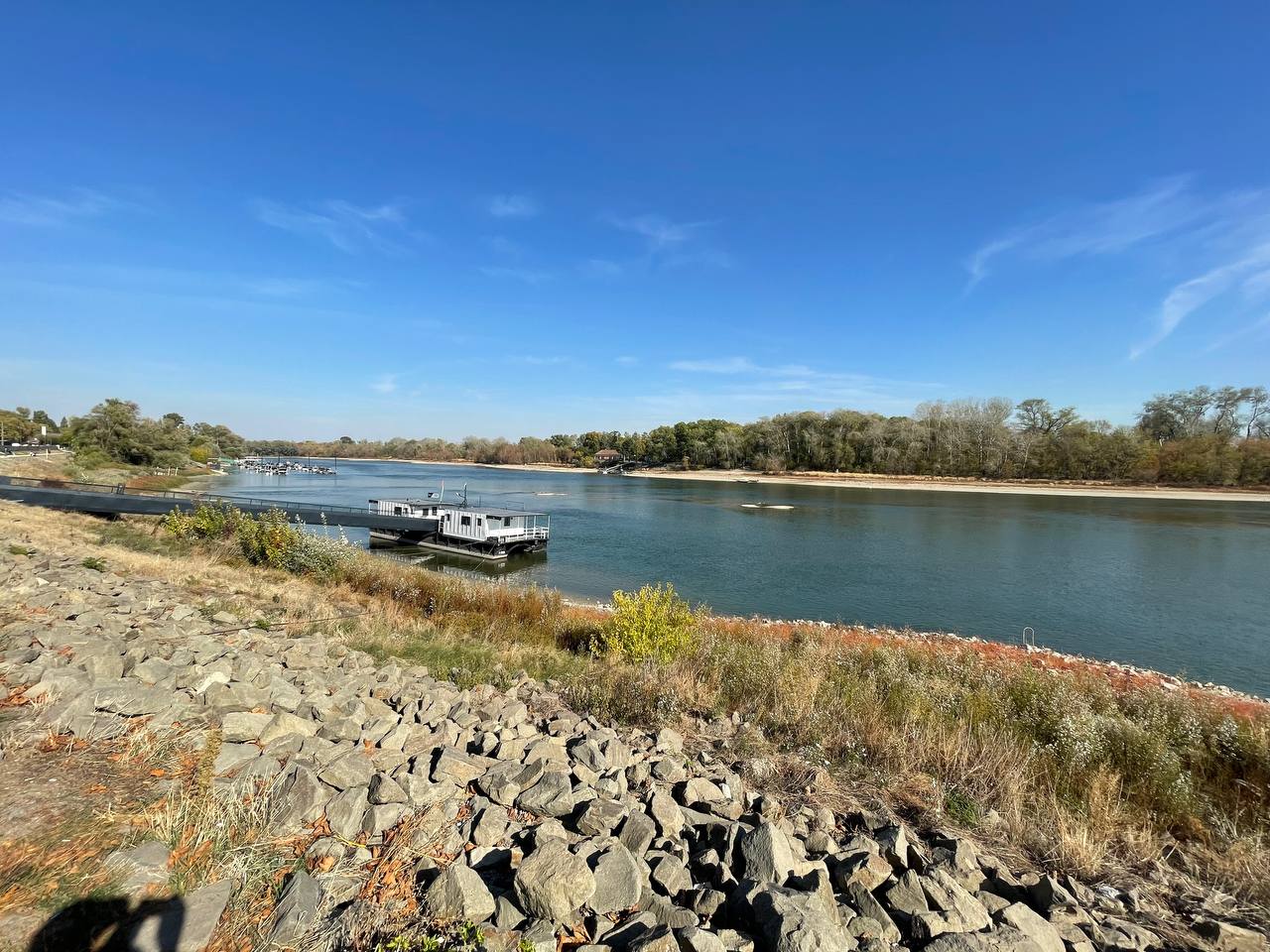
The composer’s colour sample was unavailable for comparison.
I can forgive the marketing. Standing beside it, I wasn’t especially interested in holding the river to a shade card.
It has become a recurring presence in these days. Beside the bike. Below the bridges. Against the stone in Budapest. Here again, with a different bank and different buildings behind me, recognisably itself.
There is comfort in that.
I came to Hungary with the feeling that I belonged here. Four days in, I keep finding small, ordinary ways to inhabit that feeling. Ordering coffee. Learning a sign. Taking a train out of the city and knowing that, when the day is done, I will be going back to somewhere I want to be.
Today did not need to settle any large questions.
I could stand beside the river for a while.
Then, naturally, I wanted to know what the landscape had been doing fifteen million years ago.
Some people can look at a hill and leave it at that. I apparently require its employment history.
The nearby Visegrád Mountains have a volcanic past. Research into their formation describes explosive eruptions beginning in a marine setting around sixteen million years ago or earlier, followed by activity above water: lava domes, lava flows, and avalanches of hot blocks and ash. Much of that later activity occurred roughly sixteen to fifteen million years ago.
Try laying that over the afternoon view.
Take away the roofs. The church towers. The café tables. Put violent eruptions into the region, heaps of fresh volcanic debris, hot rock breaking apart and moving downhill. Then allow millions of years of weather and erosion to soften the evidence into something you might now call a pleasant backdrop.
This is an imaginative reconstruction, obviously. I arrived several million years too late to take photographs.
Still, it changes the way you look at the hills.
What appears settled has had an extraordinarily unsettled life.
And then, eventually, somebody puts a marzipan museum nearby.
The Earth takes the long route to an acceptable holiday destination.
The only genuinely irritating part of the day arrived near the end, on the way back to the station.
The toilet cost 300 forint.
I remain unconvinced by charging admission to a basic bodily function.
Yes, there are costs. Cleaning, water, maintenance. I understand that toilets do not materialise through civic optimism. I also understand that a town welcoming visitors should expect those visitors to possess kidneys.
This should be in the planning documents somewhere.
You encourage people to come. You sell them coffee. You offer a beautiful place in which to spend several hours. Then, at the entirely predictable conclusion of that process, you introduce a small financial checkpoint.
Do you want people to piss on trees? Because that is how you get people to piss on trees.
I feel the United Nations could spare a subcommittee for this. A modest one. We needn’t begin with a binding resolution. Perhaps a working group on the principle that being alive in public should include somewhere to go.
Three hundred forint did not ruin Szentendre.
It did, however, cause me to miss my train and give me something to complain about. Fortunately the train runs every twenty minutes, so hardly a Chamartín-level disaster — however I was beginning to worry that I might have lost the ability to complain.
Back towards the station. The old town giving way to the shops, the Spar, the ordinary business of arriving and leaving.
The same approach that had seemed so underwhelming now felt rather well judged. The town had been there all along. It had simply required a little walking and a little attention.
I liked the square. I liked the steps and the passageways. I liked that the buildings were still being used, that a restaurant could be called Sour Cream, that somebody had devoted 304 hours to an edible Puskás.
I liked the river in its unauthorised colours.
Mostly, I liked having a day that could be this simple. A train, a walk, a coffee ordered in a language that is becoming fractionally less out of reach. Enough history to make me curious. Enough beauty to make me stop.
There had been a time, very recently, when getting back to the place we were staying felt like completing a sentence handed down by a vindictive judge.
Here, the thought of Budapest waiting down the line was pleasant.
We had gone out for the day.
Now we could go home.