Budapest: The Bittersweet Parting
Budapest: The Bittersweet Parting
Day seven. Paprika, unfinished instructions, and a man who managed to leave a record without leaving his name.
On our last day in Budapest, I discovered where we should have gone on our first.
This has become something of a governing principle for the trip. Begin in Santiago de Compostela and walk away from the destination. Find the affordable groceries when there is no longer any need to fill the fridge. Develop a workable understanding of a city shortly before being required to leave it.
I would call it a method, but that might suggest repeatability was intentional.
At two in the morning, we leave for the airport. Budapest to Frankfurt, then Vancouver. The itinerary calls this going home.
I understand what it means geographically.
Lehel tér. The market.
We had come for paprika, which gave the expedition a useful degree of clarity. There are days when I can spend considerable time wondering what I am looking for. Today it came in packets.
We found the market, and photographed St Margaret’s Church across the street. Another church, another brief pause outside a building whose purposes considerably predated my shopping list. By now, stopping to look seemed a perfectly reasonable thing to do. Budapest had spent a week encouraging the habit.
Then back to the practical business of acquiring something Hungarian that would fit in the luggage.
Lehel is the sort of market that makes you reconsider the decisions you have been making at the corner shop. Fruit. Meat. Eggs. Bacon. Actual supplies for living somewhere, gathered in one place, with very little apparent concern about whether they might photograph well beside a laptop.
Think Lonsdale Quay with less ceremony. Or a much more low-key Granville Island market, getting on with feeding people.
The building itself has rather more to say. László Rajk’s design dates from the turn of this century; the market’s own history records the construction of the present hall, which became known as the Kofahajó — the market traders’ ship. Budapest can make a grocery expedition sound like an embarkation.
I was mostly occupied by the prices.
Compared with what we had been paying locally, I felt we had been comprehensively had. In my notes the saving went from a quarter of the price to a tenth, which should tell you something about the direction of my irritation and very little about my suitability for compiling a consumer price index.
Dear reader: go here at the beginning.
Get your eggs. Get your bacon. Establish a relationship with the existence of reasonably priced food before the nearest convenience store establishes one with your wallet.
We were leaving in a few hours. I had finally located the starting line.
The paprika mission succeeded. Aches and pains added Tylenol to the list, giving the purchases an appealing balance between the things I wanted to bring home and the thing I would rather have left behind.
We had lángos on the way out.
There are worse ways to discover that your provisioning strategy has been fundamentally defective. Fried dough provides a useful interval between recognising an error and deciding whether to care.
A stop at the headshop/band shop along the route rounded out the expedition. Church, groceries, paprika, lángos, band merchandise. A reasonably broad account of human requirements.
We also had postcards to send.
This sounds like a small task until you attempt to complete it while moving through a foreign city, carrying other things, and gradually assembling a cold.
First, find somewhere to post them. There were red boxes, but I wanted to know whether they were still working objects or had entered that European retirement scheme in which obsolete infrastructure becomes an attractive feature you are expected to admire.
Then an address label for Carol’s blue envelope. A lovely colour, less helpful when somebody at the other end needs to read where it is going.
Somewhere among these arrangements, I factory-reset a travel router and got its wireless connection working.
Naturally.
Other people spend their last day buying a small painting. I make sure a networking device has received adequate attention. There is always one more piece of machinery whose cooperation might, with sufficient persistence, be obtained before departure.
The router worked. Jankily, but it worked.
I have lowered the threshold for several kinds of success during this holiday.
For the final day, we had considered thermal baths.
A sensible idea. Warm water. A pause. Some opportunity to let the body catch up with the fact that this was supposed to be a holiday.
We chose Széchenyi.
And there I was, standing in another queue, holding another number, being pointed in different directions without acquiring any corresponding improvement in understanding.
Budapest was making a late application for Madrid’s job.
I had not expected this. We had established a relationship. I liked the place. It generally seemed prepared to allow me to get where I was going, a courtesy Madrid had treated as a dangerous precedent.
Now I was at the baths, feeling like somebody in the waiting room in Beetlejuice, taking an increasingly professional interest in the business of shrinking heads.
There is a particular insult in becoming stressed while attempting to purchase relaxation. You have identified the problem. You have travelled to a facility specialising in its opposite. You are now being issued additional problem. Instructions unclear would be an understatement.
Széchenyi opened in 1913, following earlier deep drilling in City Park and an artesian bath operating there in the nineteenth century. Engineers had successfully brought hot water up from underground.
Getting one visiting Canadian pointed in the correct direction remained a separate undertaking.
I was willing to concede that the engineering problem had been harder. Emotionally, the distinction was not helping.
Still, Budapest would have to do considerably more than this to dislodge my affection. Madrid had destroyed two weeks of accumulated holiday calm in less than forty-eight hours. A confusing visit to the baths was irritating, but the city had built up reserves.
I could be annoyed here without feeling that the whole place wanted me gone.
That difference matters.
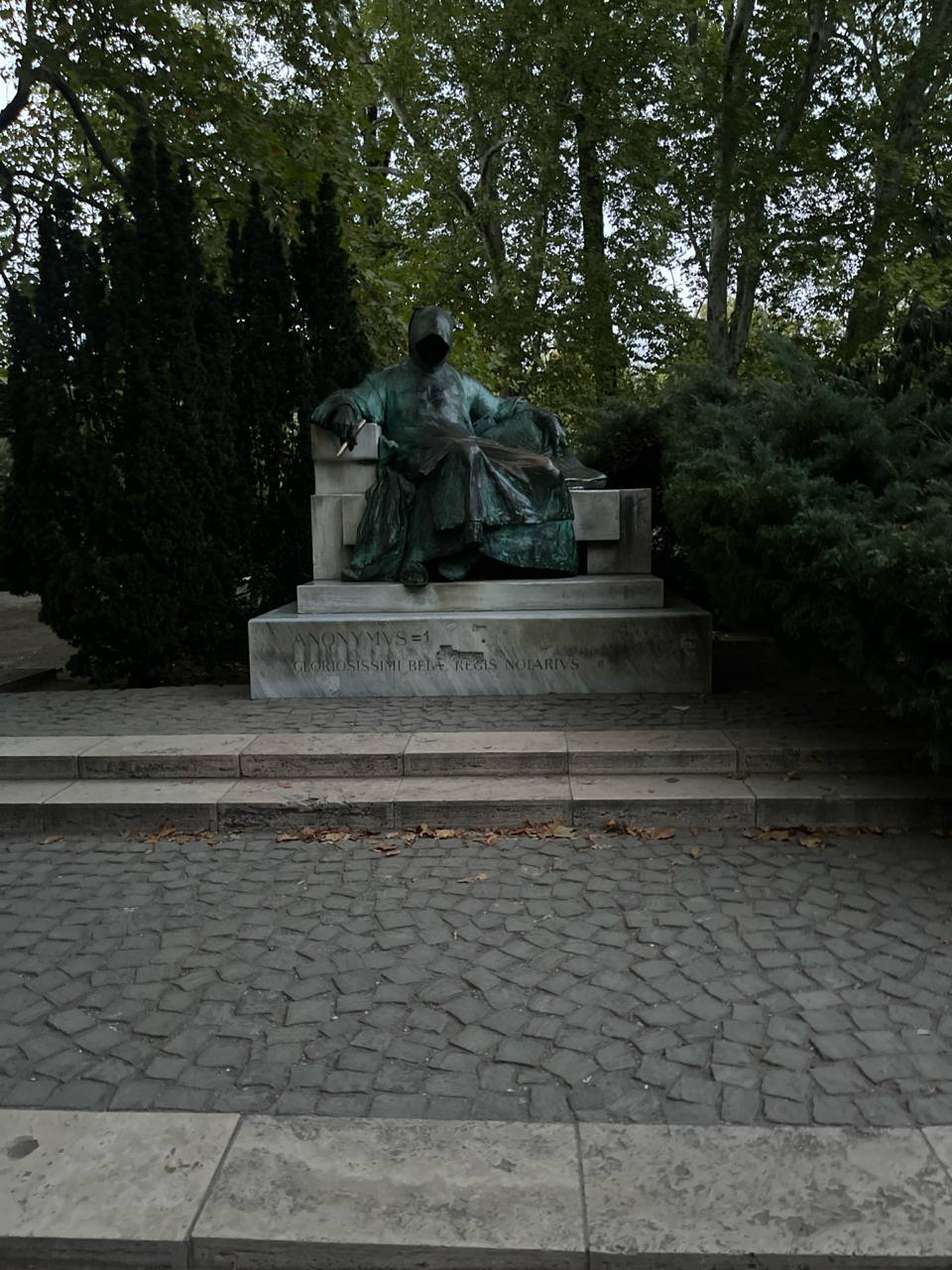
In City Park, near Vajdahunyad Castle, we came across a seated bronze figure in a hood.
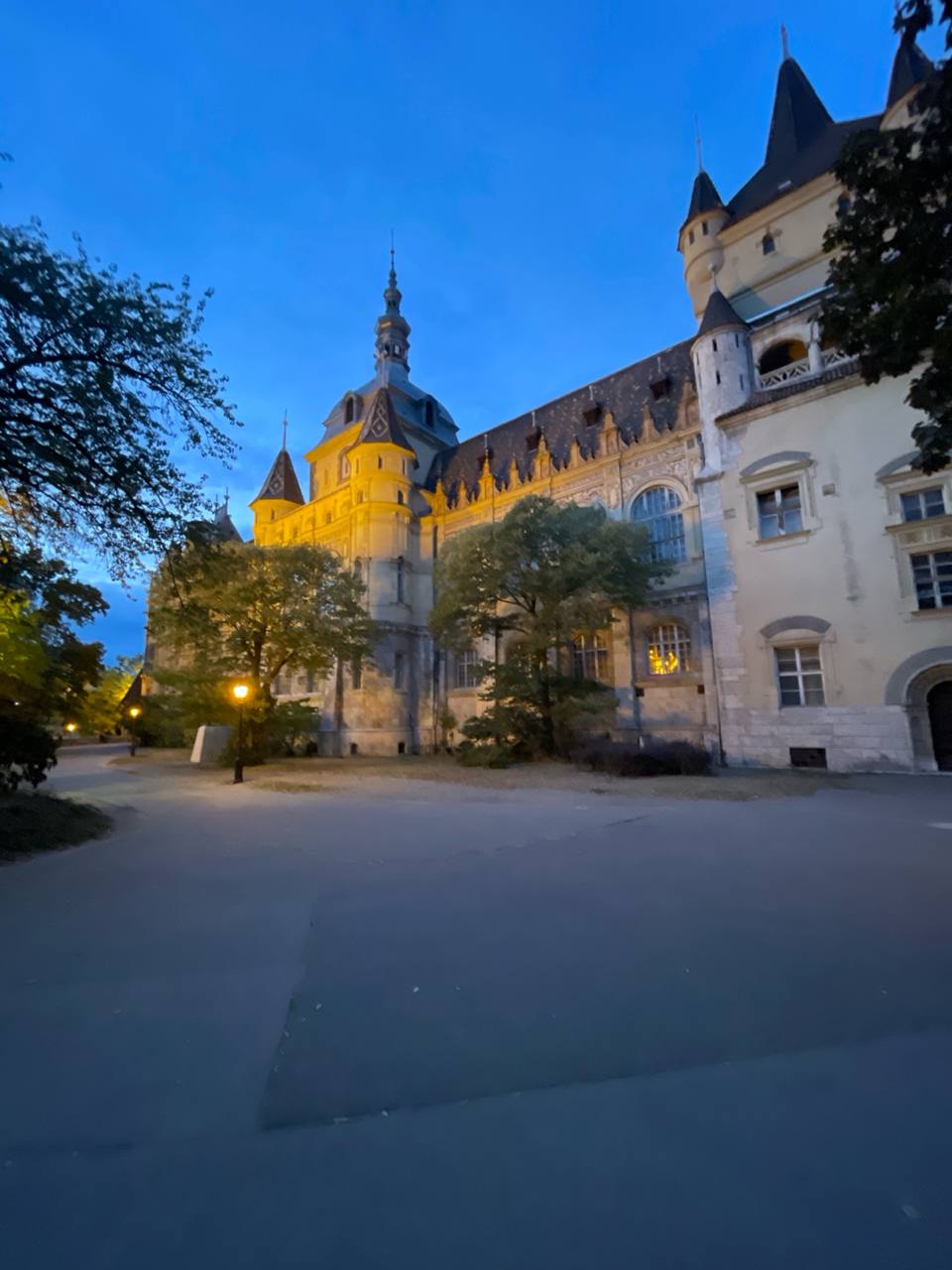
A book. A pen. A face held back by shadow.
I did not know who he was.
This was, it turned out, unusually appropriate.
Anonymus.
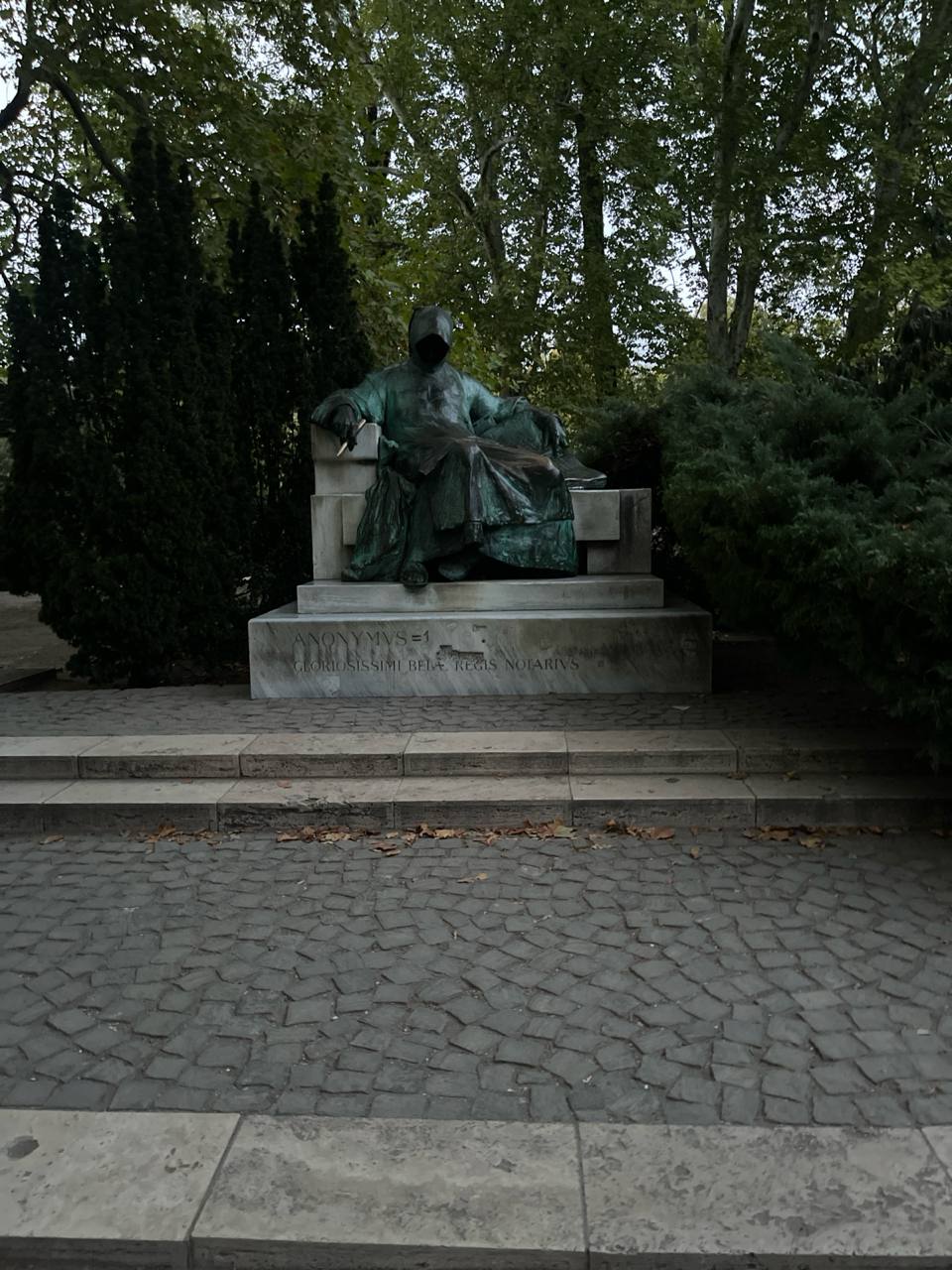
I asked about him, read what I could, and felt the small recognition that sometimes arrives before you have all the information. There was an irony here, a private echo in the name.
I knew then that he belonged at the end of this story.
But there was still some day left to get through.
At the 1956 memorial, the metal came up out of broken ground.
From the pointed end, it looked like a single sharp force. Further back it became rougher, separating into square posts, individual pieces standing apart. I could see the change before I understood what it meant.
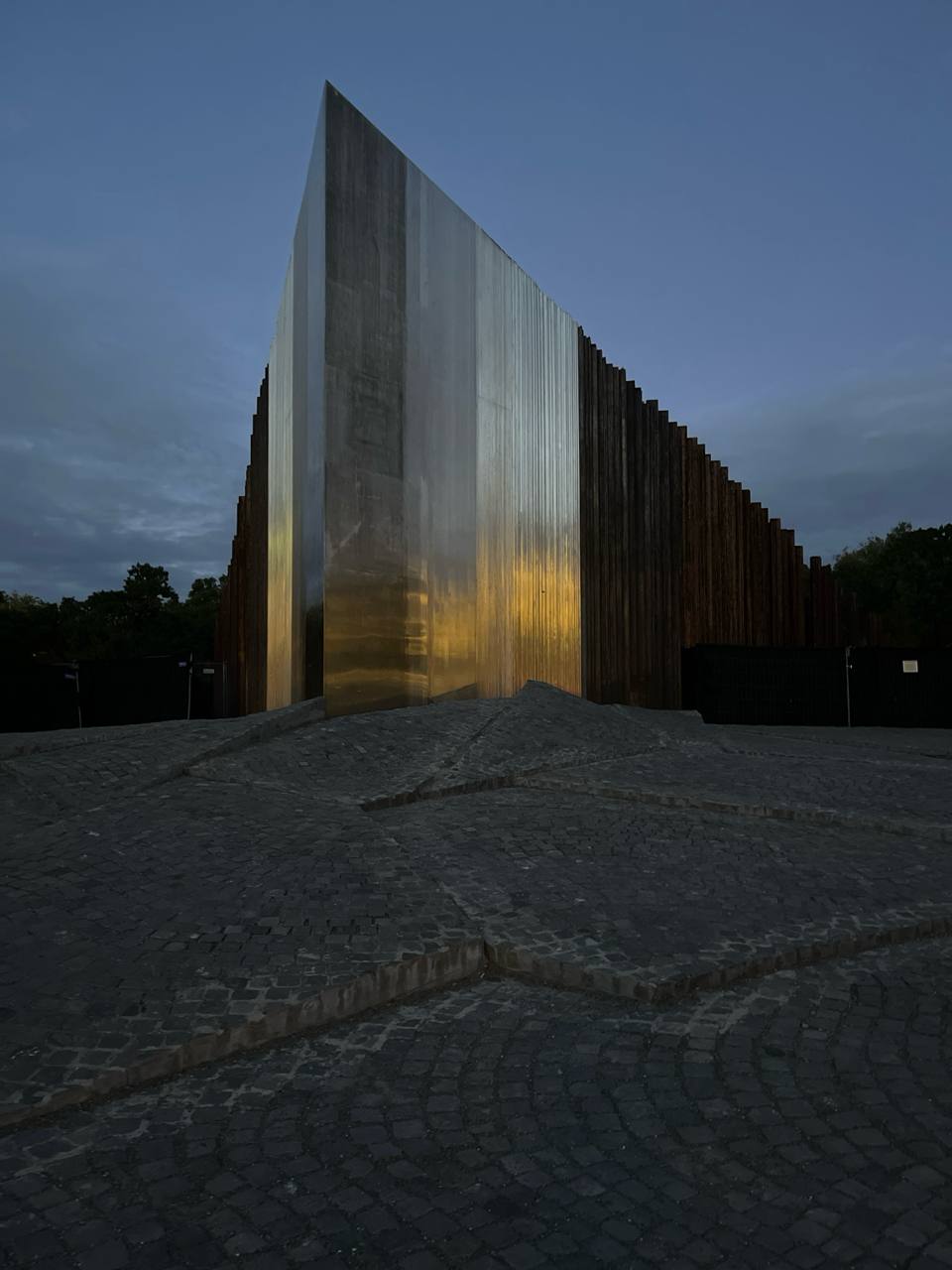
The designers, i-Ypszilon, describe the movement in the other direction: separate, weathered columns gathering more closely, growing taller and brighter, becoming a steel wedge. People joining together. The force of common purpose breaking through the paving.
Once you see that, the separate posts become difficult to regard as merely metal.
There is room between them for the thought of a person. Someone who has to decide whether to go outside. Whether to join the others. Whether the people beside them will stay.
Then the gaps close.
The memorial was unveiled in 2006, fifty years after the uprising. Nearby stood the enormous Stalin statue pulled down in October 1956. This ground had already experienced a fairly direct public reconsideration of whom a monument should honour.
The city was moving towards dusk.
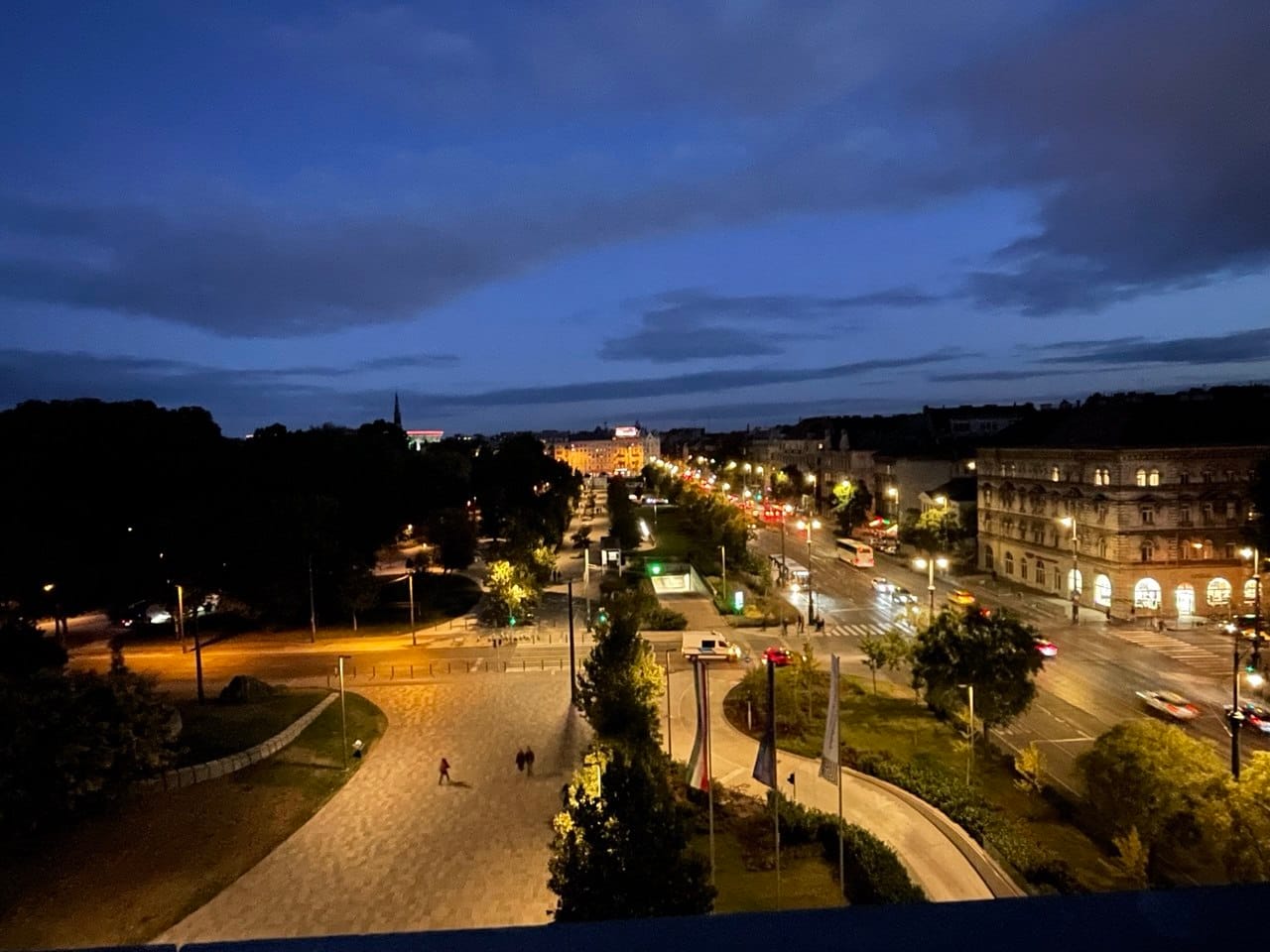
After the House of Terror, after the cells and the accounts of what happened to people who fell into the machinery, this gave me another shape to think about. Individual people finding enough trust in one another to move together.
The steel holds that moment. It cannot make the decision easy, even in retrospect.
I stood looking at the point where the paving gave way.
Dad’s postcard showed Heroes’ Square.
I wanted to put something useful on the back. A little history. Some sense of the place. The sort of message that gives the person receiving it more than evidence that you successfully located a stamp.
This required reducing Hungary to the space left beside an address.
I tried to make it short. The history resisted. There is always another king, another uprising, another qualification that would prefer not to be omitted.
Then I had trouble with the stamp.
After a week contemplating medieval charters, Roman inscriptions, electrical engineering, and the mechanisms by which civilisations preserve knowledge, I had reached the edge of my competence at the adhesive rectangle.
“Instructions unclear.”
I want that on my gravestone.
It would explain a great deal while leaving sufficient room for the dates.
The postcard mattered, though. Dad would recognise the place differently from me. Family makes geography uneven that way. A square can be a visitor attraction and also somewhere you want your father to see you standing, even when all you can send is the printed version.
I wanted a little of this place to reach him.
Preferably with the postage attached correctly.
As the day ran out, the bike box began to occupy more of my attention.
Two words. Bike box.
A bicycle is a marvellous means of transport until you need another means of transport to carry it. Then it becomes an awkward piece of sculpture requiring advance negotiation.
Our airport transfer had become the final point on which a substantial amount of money and several carefully connected events depended. I wanted to know what happened if the driver did not turn up.
There were assurances. There were consequences for drivers who failed to appear. There were terms explaining why the arrangement ought to work.
At some point before dawn, however, what I would need was a car large enough for the box, physically present.
Contractual disapproval would be difficult to load the bicycle into.
I did not like the feeling of being on a high wire above a ten-thousand-dollar mistake. I wanted a backstop. A second possibility. Something more substantial than being told how unlikely the first failure was supposed to be.
The holiday was ending in the familiar business of trying to make several independent systems agree about where we should be.
Carol and I had spent a week getting ourselves around Budapest. Tomorrow the distances would become rather less forgiving.
There are things I am bringing back that will not need to go through baggage handling.
The House of Terror is among them.
I keep thinking about the usefulness of information to whoever acquires the power to use it. Names. Associations. Beliefs. The details that let an authority find a person and decide which category they belong in.
Once you have built the means to classify people, a change of leadership does not require starting again with a blank sheet. The intentions under which something was collected cannot supervise every subsequent use.
That is the question I am carrying back to Canada, and I do not feel reassured by being told that our intentions are better.
I would like to know what happens when the intentions change.
The Canadian Civil Liberties Association’s criticism of Bill C-34 raises concerns about broad regulatory power, expression, privacy, and the age checks the proposal would produce. Those are questions worth asking while the machinery is being designed. Once people have organised their businesses and institutions around it, taking it apart becomes a much more complicated proposition.
A retention policy states what someone is supposed to do. I still want to know about the copies, the connected records, the backups, the contractors, the breach, the next government. I want to know what remains available after the reassuring sentence has finished doing its work.
I have become deeply tired of the idea that asking those questions is itself evidence that something is wrong with the person asking.
The answer cannot always be to trust the people currently holding the keys. Locks generally outlive appointments.
Hungary has given me a week of buildings and objects that make the past difficult to dismiss as an abstract concern. Some held people. Some held books. Someone had to decide what would be done inside them, and someone else eventually inherited the decision.
At Pannonhalma, people had worked to keep a library alive. At the museum, I had seen what could be done when a human life became an administrative problem. Here in the park, separate pieces of metal gathered into the shape of people refusing to remain separate.
I will be thinking about these things for longer than the flight.
And yet I am also bringing back the ordinary week.
Groceries. Bridges. A glass of wine. Carol finding a way home when the beer had affected my contribution to the process. A police officer coming up a hill to investigate a red light and staying to look at another galaxy.
Those things belong together in my memory. Budapest has room for the weight of its history and for somebody to sell you fried dough on your way out of the market.
I came here already loving it. Being here has made that feeling harder to explain briefly.
The ancestry is part of it. The marks in the stone beside the Danube. The thought of hands belonging to people whose lives eventually led to mine. The strange familiarity of a city in which I still need considerable help finding things.
Belonging apparently does not include automatic navigation.
I have stood by the river asking where I should live. I have looked at a coin and allowed it to remain a question. I have had a week in which saying “home” about our temporary accommodation came easily, while saying it about the return flight requires a little more thought.
At two in the morning, we leave.
The Danube will carry on past the stones. Morning will arrive at the market. Somebody will buy the eggs I finally learned where to find.
I wish we had longer.
Which leaves the man in the hood.
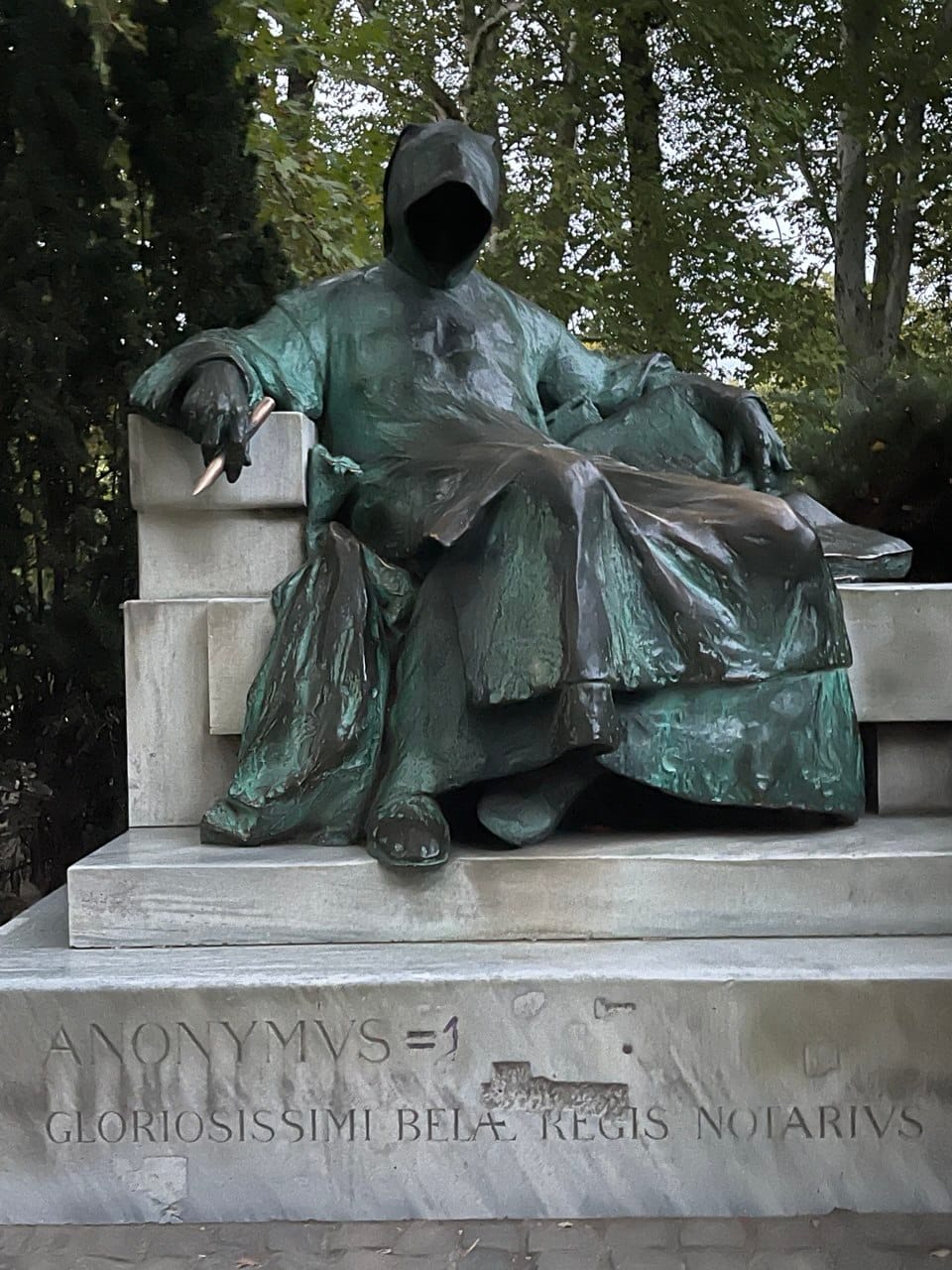
Miklós Ligeti made the statue in 1903. Its subject lived centuries earlier: the chronicler we call Anonymus, associated with the court of King Béla, usually understood to be Béla III.
His Gesta Hungarorum tells of the deeds of the Hungarians. The National Széchényi Library dates its surviving medieval manuscript to the thirteenth century, with the work itself generally placed around 1200. The text travelled through other hands. The identity of the man who first wrote it remains uncertain.
He was writing a version of the past, with the concerns of his own time present in it. A chronicler has a point of view. So, demonstrably, does a man who has just spent a week explaining his relationship with Budapest.
But there is something that holds me in that bronze figure. The book open. The pen ready. The face difficult to see.
After all the names I have tried to read this week, here was someone remembered by the absence of one.
Yesterday, I stopped in front of a Roman stone because somebody had wanted a name to survive. Today, I stopped in front of a writer whose words had made it through without carrying his identity intact.
Both had reached me.
I know someone who would appreciate that. Someone for whom the name on this pedestal would have a familiar sound.
I will leave it there. He would prefer it that way.
Soon we will take our bags and the awkward bicycle and begin the long business of going home. For this last page, I would rather leave the park quiet, the book open, and the man beneath his hood.
There is still something to write down.
Anonymus.