NGC 7635 — The Bubble Nebula in Foraxx Palette
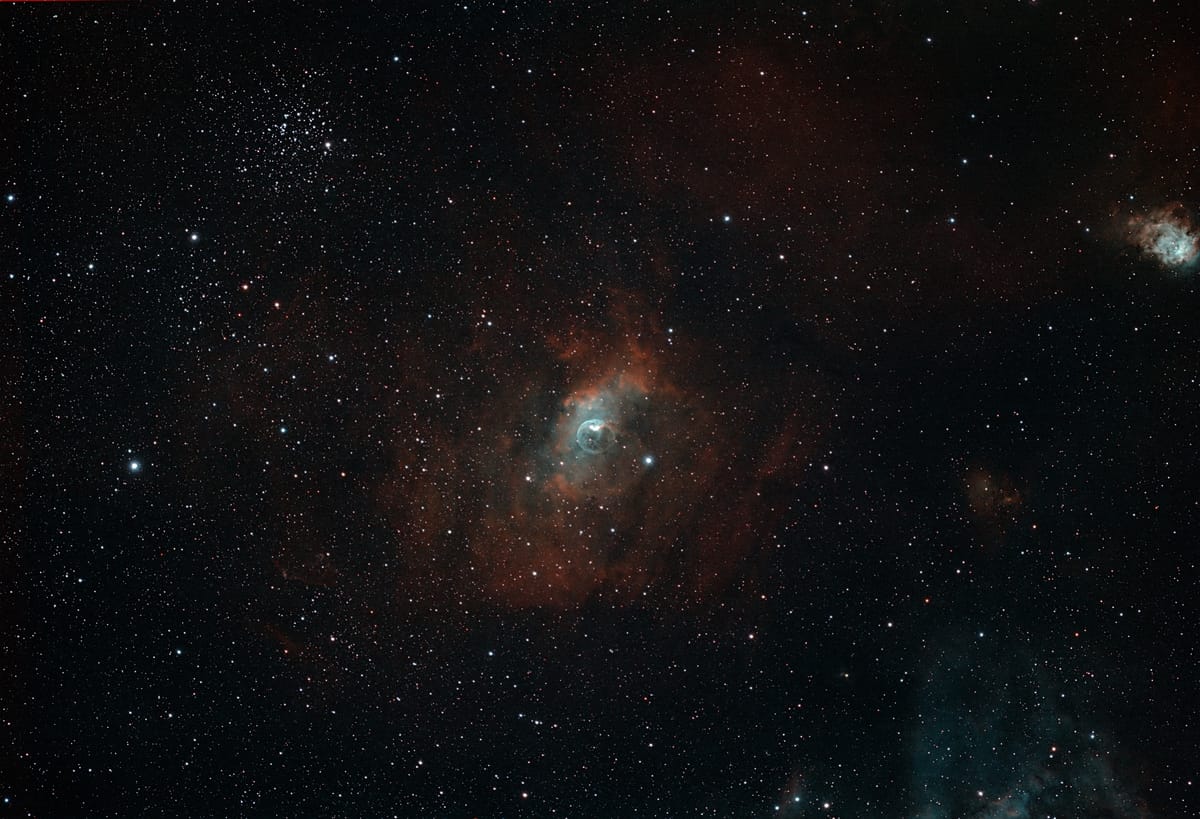
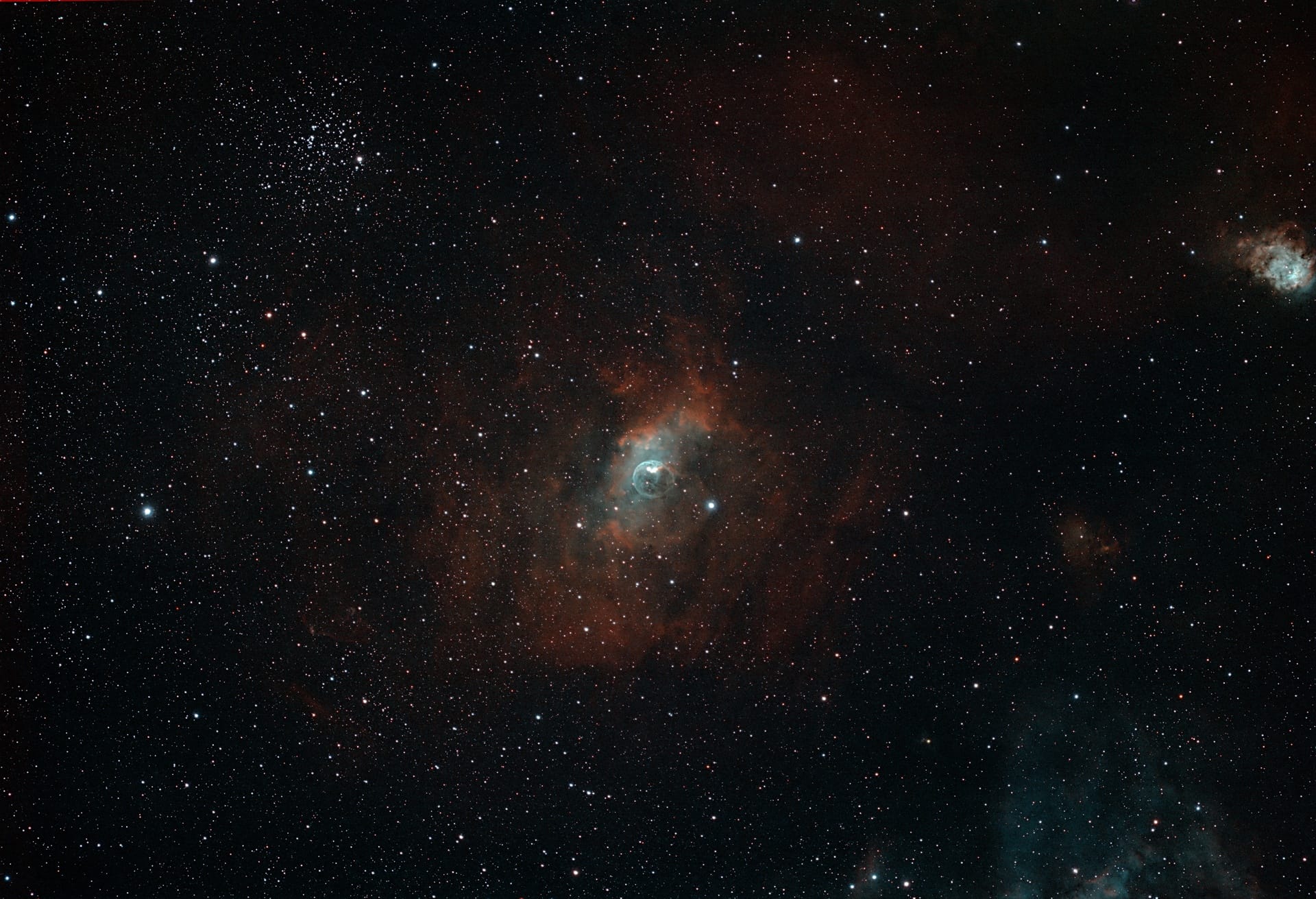
At first glance this image looks like a pearl set in rust. The Bubble Nebula sits at center-left, a near-perfect sphere of ionized gas 10 light-years across.
The bubble is carved by the stellar wind from BD+60°2522 – a Wolf-Rayet star 40 times heavier than our Sun cooking at 40,000 K surface temperature. Its wind screams outward at 2,000 km/s, sweeping surrounding material into that distinctive shell. BD+60°2522 is only about 4 million years old and already on death row – a star this massive can't hold itself together forever. It will end as a supernova within the next 10 to 20 million years. When it goes, the detonation wave will collide with the very bubble it created.
Three narrowband channels mapped to color in the Foraxx palette: hydrogen alpha at 656nm forms the structural backbone in green, oxygen III at 501nm fills the hot interior in blue, sulfur II at 672nm traces the outermost shock front in red. Roughly 24 hours of total integration across three filters.
Three objects in a single frame:
The Bubble Nebula (NGC 7635) – 7,100 light-years away in Cassiopeia. Only 15 arcminutes across on the sky, about half the diameter of the full Moon.
M52 / NGC 7654 – The Salt and Pepper Cluster – look at the upper left quadrant of the frame. That tight concentration of roughly 100 stars is M52, an open cluster about 5,000 light-years distant. The "salt and pepper" name comes from the visual mix of bright and faint stars that gives it a granular texture through an eyepiece. Discovered by Pierre Méchain in 1774.
NGC 7538 / Sh2-158 – The Northern Lagoon Nebula – the diffuse reddish emission region in the surrounding field, 9,100 light-years away near the Cassiopeia-Cepheus border. This active star-forming region contains one of the largest known protostars ever discovered, estimated at roughly 300 solar masses still in formation.
The Foraxx palette takes its name from a mashup of "false," "OIII," and "H-alpha" – a custom hybrid that produces more natural-looking false color than the traditional Hubble Palette.