Elephant Trunk Nebula — IC 1396
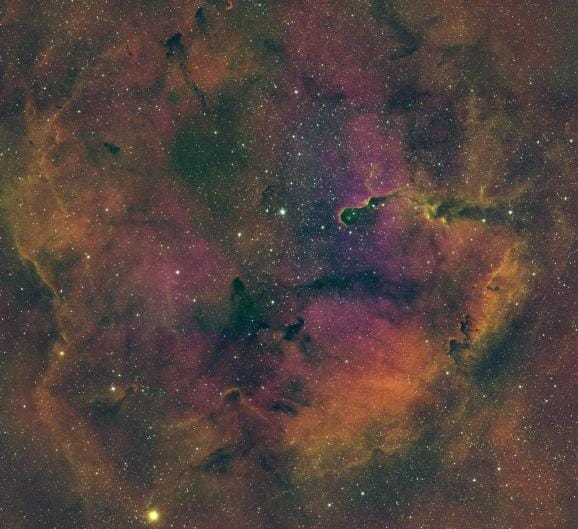
Sharpless 2-131, better known as the Elephant Trunk Nebula — a star-forming region in the larger IC 1396 complex, roughly 2,400 light-years away in Cepheus. The trunk-shaped dark nebula at the heart of the image is a dense cloud of dust and gas being sculpted by radiation from a nearby massive star, pushing the material into pillars that resemble an elephant's trunk.
This is an SHO narrowband composite, processed to emphasize the chemical structure of the region. The deep reds are hydrogen-alpha emission from the surrounding ionized gas. The blues and teals trace oxygen — shocked and excited by stellar winds. The golden and orange tones come from sulfur, which tends to glow in lower-energy regions where the gas is denser.
The trunk itself is dark because the dust in that column is thick enough to block nearly all the light behind it. Inside those dark pillars, gravity is winning — stars are forming right now, hidden from optical view but detectable in infrared.
This was a three-filter mosaic: six panels across the target, one hour of integration per panel per filter. Eighteen hours total, captured over multiple nights.
Technical Details
- Object: IC 1396A — Elephant Trunk Nebula
- Distance: ~2,400 light-years
- Telescope: 80mm refractor @ 600mm FL
- Mount: Celestron CGE
- Filters: SHO narrowband
- Integration: 18 hours (6 panels × 3 filters × 1h each)
- Location: Victoria, BC
Shot and processed with SharpCap for acquisition, and one very smart AI personal assistant handling the overnight automation, plate changes, and filter corrections after I fell asleep.