Our Nearest Neighbour: M31 in 60 Minutes with a Dwarf 3 Pro
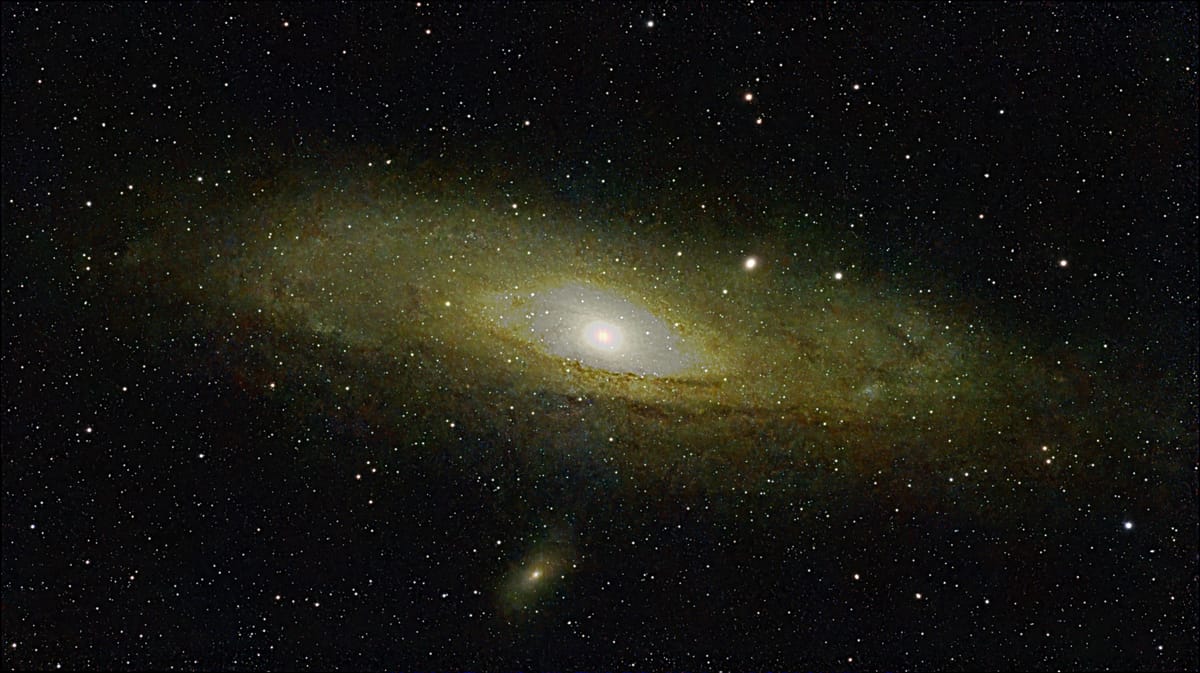
When you're used to a 16" Newtonian on a CGE Pro mount, a telescope you can fit in your carry-on feels like a toy. But the Dwarf 3 Pro — a smart telescope I've got on loan — has been quietly changing my mind about what "portable" astrophotography can deliver.
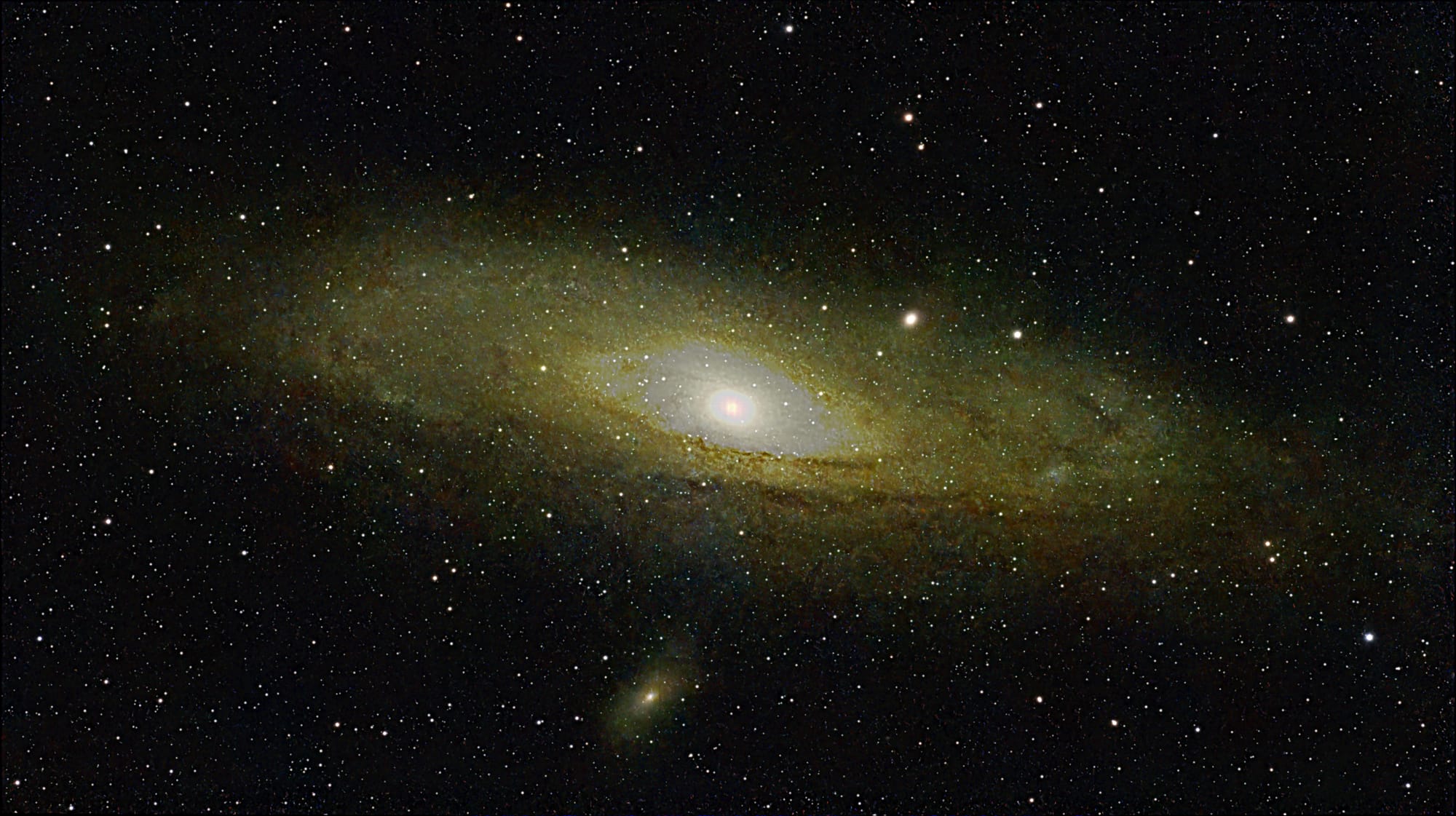
This is M31, the Andromeda Galaxy. Our nearest major galactic neighbour, 2.5 million light-years away. One hour of total integration time from my backyard in Victoria. No guiding, no autofocuser, no obs platform — just a telescope small enough to pack next to a change of clothes.
And I'm bringing it with me to Europe.
Why a carry-on telescope changes things
Victoria clocks in at 48° north — great for circumpolar objects, terrible for anything below about −20° declination. Low-latitude targets like Omega Centauri, the Sculptor Galaxy, and the Southern Pinwheel have been effectively off-limits. A small scope that flies with you opens that part of the sky for the first time.
I'm headed to Pontevedra, Spain for the 2026 World Triathlon Championship Finals. Same latitude as Victoria? No — Pontevedra is at 42° north. Over 5° further south. That's enough to get below the horizon on a handful of objects I've never been able to image from home. The Dwarf 3 Pro is coming with me.
The Dwarf 3 Pro, in context
It fits in a carry-on. It runs on a phone app. It costs a fraction of what a filter wheel alone would set you back on a big rig. And — as the image above shows — it can pull detail out of the brightest galaxy in our local group with an hour of stacking.
No, it's not the 100-megapixel mosaics I get from the big 16" on the CGE. Different tool, different purpose. This one sacrifices resolution for portability and gets you good enough results from a hotel balcony. For quick sessions, grab-and-go, and travel, that trade-off makes sense.
M31 — the galaxy that's coming for us
Current models put the Milky Way-Andromeda collision at roughly 4.5 billion years from now. The two galaxies will pass through each other, pause, fall back, and eventually merge into a single elliptical galaxy — sometimes called "Milkomeda." Individual stars won't collide (space is mostly empty), but the gravitational dance will shred the spiral structure of both galaxies. From Earth's perspective, if anyone's still around, it'll be the slowest car wreck in history unfolding across the entire sky.
But that's 4.5 billion years away. For now, it's just a gorgeous target for a tiny telescope on a borrowed tripod. And next week, it'll be a gorgeous target from a different latitude entirely.
Capture details: Dwarf 3 Pro (on loan), ~1 hour total integration, processed in Siril and SETI Astro Suite Pro. Backyard, Victoria BC.