Crab Nebula — M1
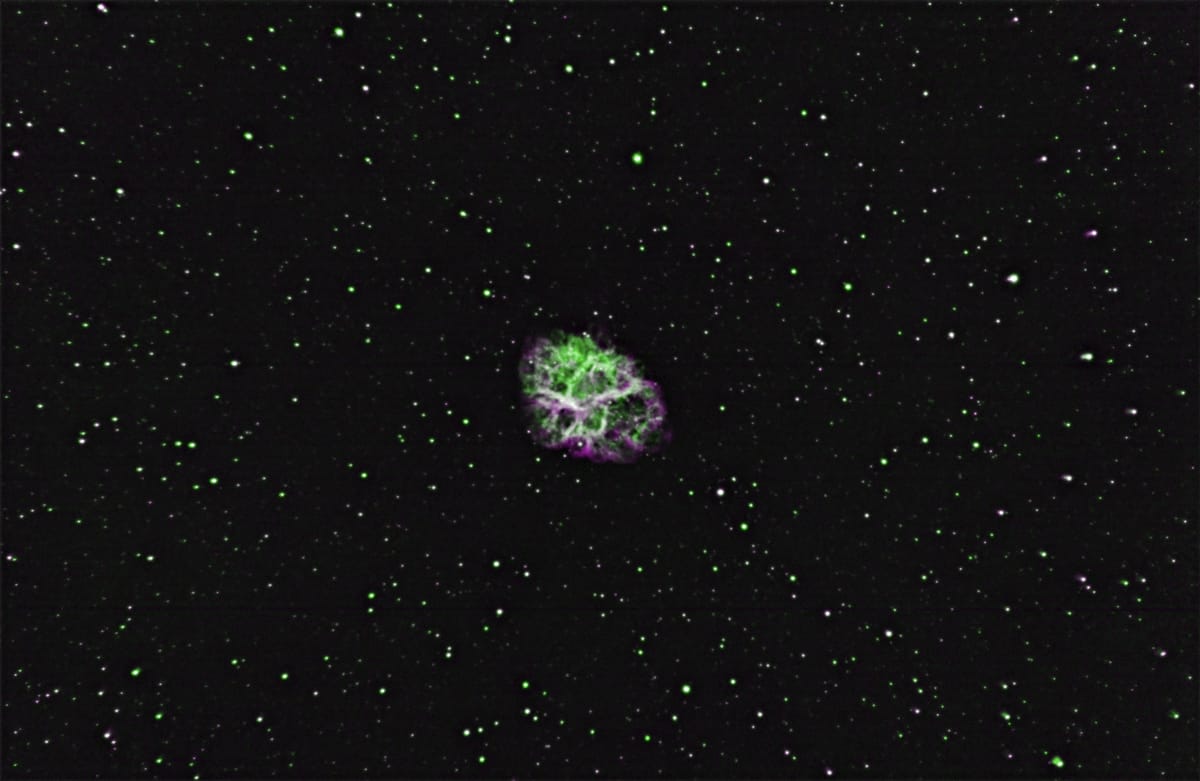
The Crab Nebula is the remains of a supernova observed by Chinese and Japanese astronomers in 1054 AD. They recorded a "guest star" bright enough to see in daylight for 23 days. What's left is this — an expanding cloud of debris with a pulsar at its heart, spinning 30 times per second.
The filamentary structure you see is the ejected material from the explosion, still racing outward at 1,500 km/s nearly a thousand years later. The different colors in the SHO Hubble palette reveal the chemical fingerprints of that ancient star's interior — elements forged in the core and scattered into space.
Eight hours of integration. Not a lot by deep sky standards, but the Crab is bright and rewards modest exposure times.
Technical Details
- Object: M1 — Crab Nebula
- Distance: ~6,500 light-years
- Telescope: 80mm refractor @ 600mm FL
- Filters: SHO narrowband
- Processing: Hubble palette
- Integration: 8 hours
- Location: Victoria, BC